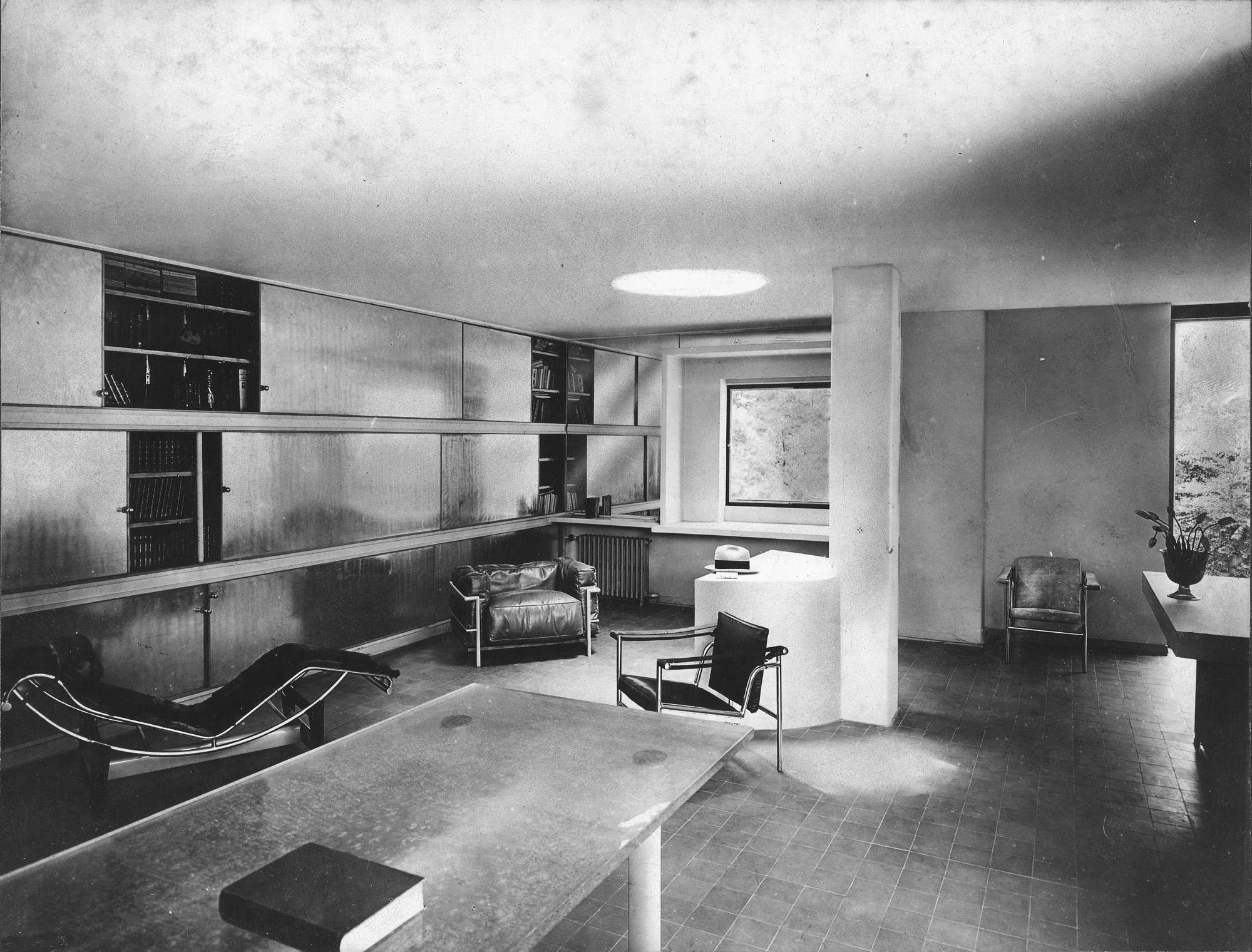
Curator, Barry Bergdoll: At the end of the 1920s, Le Corbusier designed this villa and several other pavilions for Henry Church, a wealthy American expatriate living in a tony Paris suburb.
The architect also designed the furniture, using industrial materials not normally associated with domestic interiors.
Architect, Jean-Louis Cohen: The various types of seats one sees are based on a thorough analysis of the anatomical requests of the human body. It belongs to the world of the machine. He’s using machine-made elements such as chromium-plated tubes. He’s alluding to a world of a mechanical object that will be so fundamental in the development of Le Corbusier theories.
The Music Pavilion at Villa Church is the first domestic environment in which this new furniture is arranged. And in fact, it is arranged in order to create a sort of interior landscape: a collection of objects that play with each other, in space, as if they were pieces on a ground in the outdoors.
Barry Bergdoll: With a team of like-minded designers, Corbusier sought to make furniture for a new era—and a fast changing demographic.
Jean-Louis Cohen: At the end of the 1920s, Le Corbusier works together with his cousin and partner, Pierre Jeanneret, and the young interior designer Charlotte Perriand, at the design and the production of steel tube furniture.
Charlotte Perriand was active in politics, active in design, active in photography And she conceived this furniture for women of her generation who were doing sports, were dancing, were no longer completely wrapped in turn-of-the-century dresses.