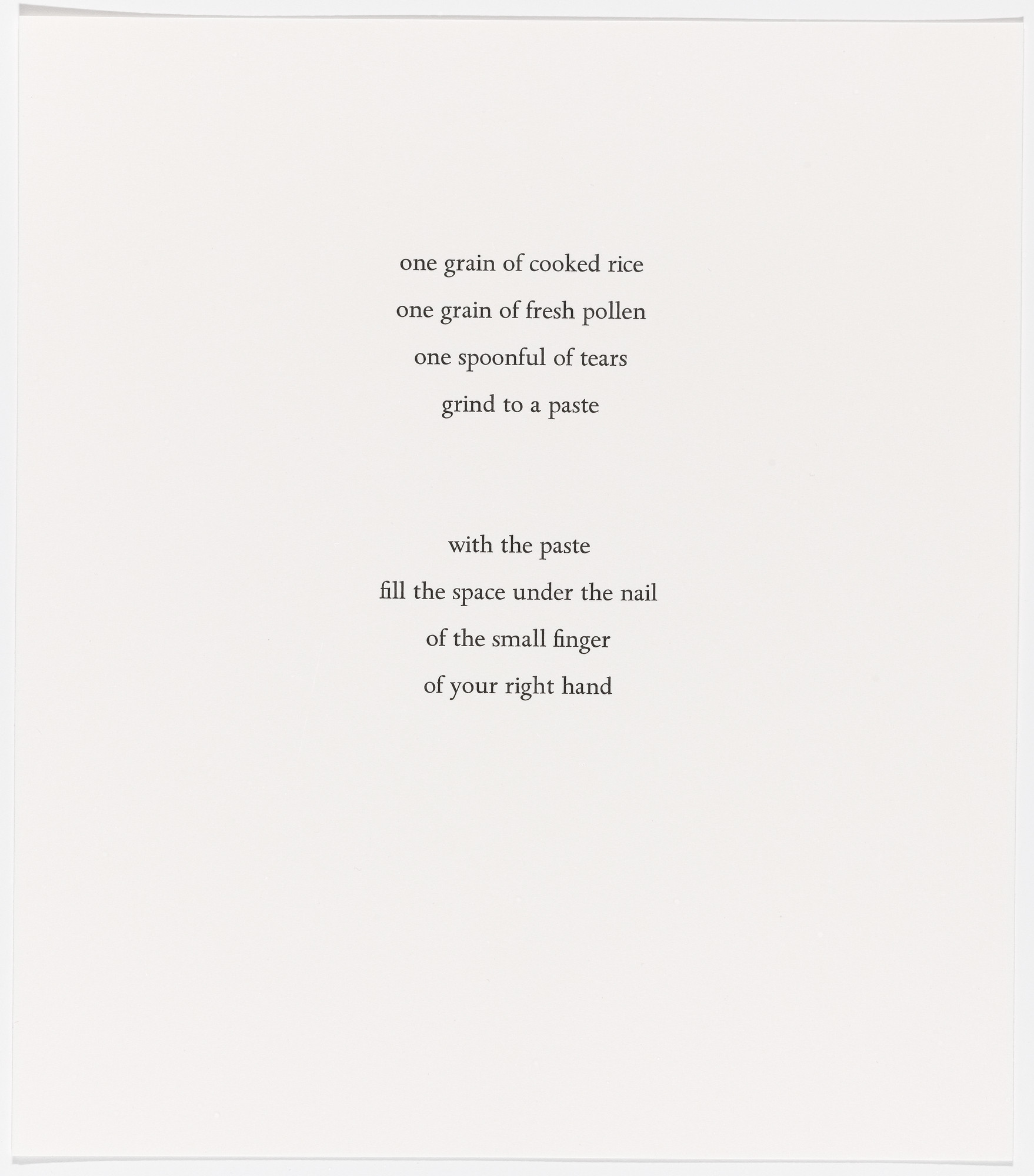
GLENN LOWRY: Marina Abramović made this portfolio with printer and publisher Jacob Samuel, who, since 1988, has run his own imprint, Edition Jacob Samuel, in Santa Monica, California. Over many such collaborations with artists, Samuel has learned how to adapt the traditional process of etching to the diverse practices of contemporary artists. He has also learned that artists often work best in their own studios. Jacob Samuel.
JACOB SAMUEL: In 1994, I designed a portable studio that I could put in a crate and ship all over the world so I could work with artists in their own studios. I wanted to be able to work with artists in their own environment and see where that would lead.
GLENN LOWRY: Abramović was one of the first artists to take advantage of his portable studio. Samuel worked with her for two days in her Amsterdam studio and returned to Santa Monica with the plates for Spirit Cooking.
JACOB SAMUEL: Marina was very open to whatever I suggested in terms of technique, but right away, I could see that she had a very specific working process.
Because she’s a performance artist and because she uses her body for everything, she was a little uncomfortable drawing with, a pencil or an etching needle, so I suggested that we use soft ground and that she draw with her fingernails. And occasionally, she would use her fingerprints. She used spitbite aquatint, which she liked to use because it actually mixes the artist’s saliva with nitric acid. So again, it’s relating to her body.
This is exactly what I hoped would happen by creating a portable studio, that the artist would be so in tune with their own environment, that translating it into another physical context would be irrelevant.
GLENN LOWRY: After several years, Samuel set aside his portable studio in order to focus on working with artists again in his studio space. But these earlier experiments had certainly left a mark on this practice.
[TRISHA DONNELLY AUDIO INTERVENTION]