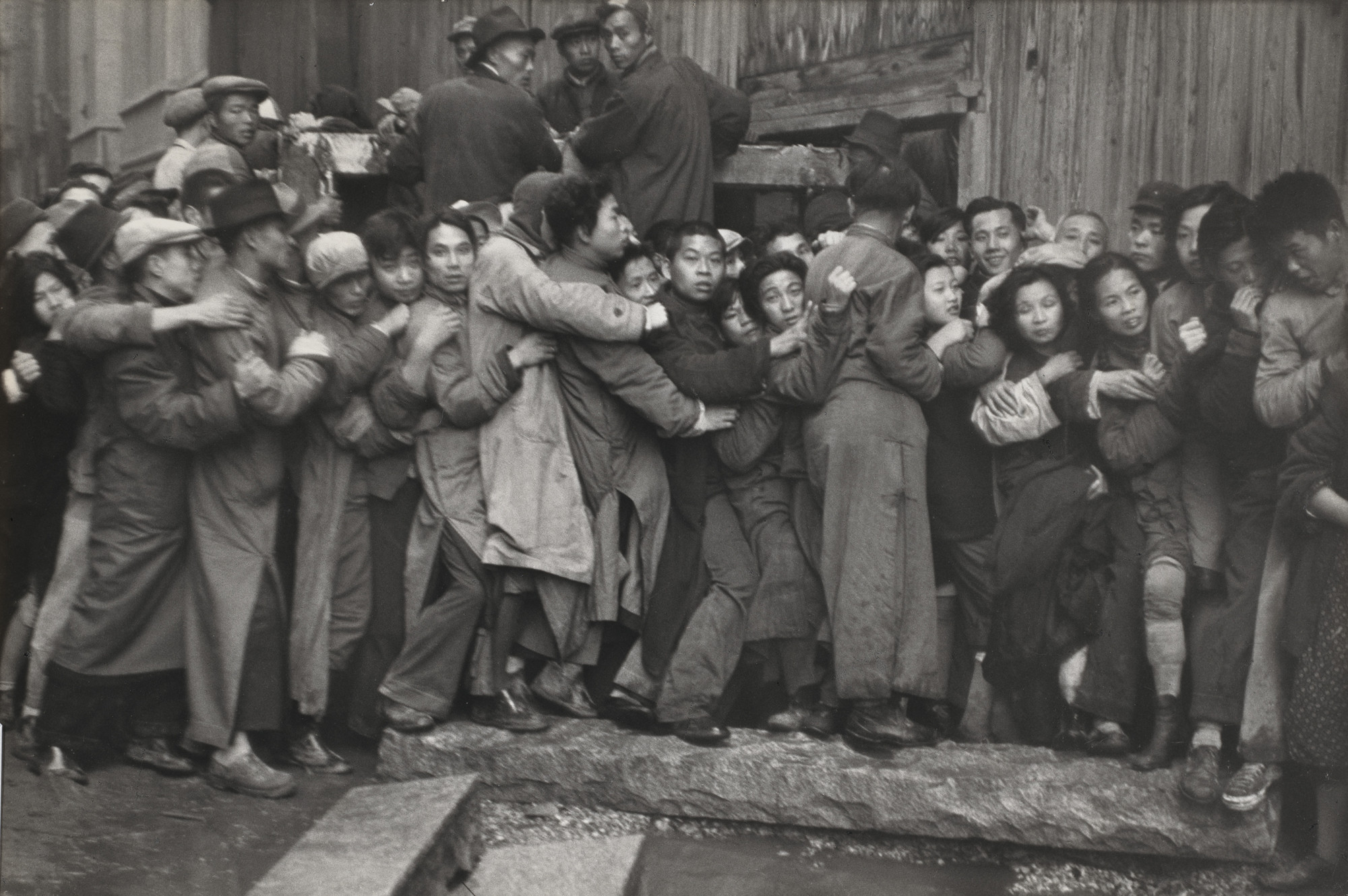
Curator, Peter Galassi: In the fall of 1947, Cartier-Bresson left for Asia where he was for the next three years. India, Pakistan, Indonesia, Burma, were all becoming independent nations. And then the Communist Chinese Revolution unfolded. This is a picture made in Shanghai in December 1948, when Shanghai is still nominally under control of the Chinese Nationalists. But everybody knows the Communists are on their way, and they're going to win. And the people that we see in the picture are struggling for position to get to the bank, in order to redeem their paper money for gold because they know that as soon as the Communists arrive, the paper money is going to be worthless.
Cartier-Bresson's best photojournalist work not only very vividly describes the scene itself, but because of its concreteness, and its specificity, it also rises to the level of metaphor. It's like the panic of all crowds, of all times.
In the vitrine cases that are right below the pictures, you see three different examples of how this picture was used. In every case, the picture is cropped, is less powerful, and is joined by other lesser pictures.
Most of the time he's sending back undeveloped film And the film is then developed, edited, printed, selected and laid out, captioned, and reproduced in the magazines, without him having any control at all.