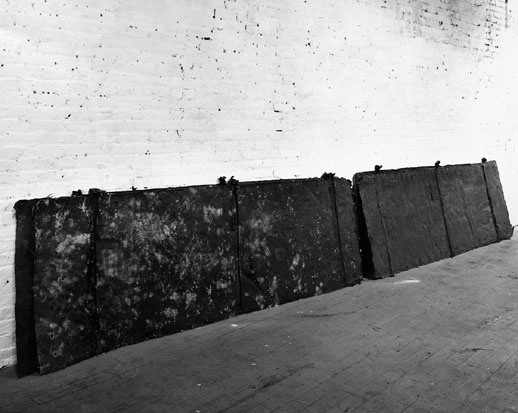
Artist, Richard Serra: In the 1960s I was living on Greenwich Street, and they were tearing down the piers at the time, right in front of me - The Erie Lackawanna Pier, actually. And I would go down there and rummage through the debris, to see if I could drag anything up to my loft and use it.
And there were these old doors and troughs. And I thought it was a good potential for casting something actually, to recast the door. And so I cast the doors in rubber and backed them with fiberglass. And actually made them look exactly like the doors looked, only in a different material. And they had the look of kind of dirty skin, or elephant skin, to them.
These pieces were abject in their look, because they really looked like something that had been discarded. But then, when you actually looked at them, you realized that somebody had gone to a great deal in length to make something that looked like something that had been discarded. So, it wasn't just a found object.
At that point, what I really had to do was get beyond the [Marcel] Duchamp legacy. What Duchamp had done, in the early part of the century, was to present a manufactured object as a work of art: namely, a urinal. And after that, other objects— shovels, or whatever. And what it did was it opened the door for any object to be presented as a work of art. I was much more interested in the invention of form. And I'm still interested in the invention of form.