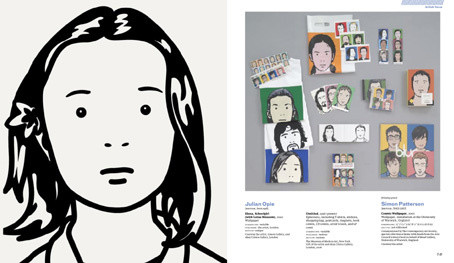
DEBBY WYE: Julian Opie's experimentation with digital technology represents the newest frontier in printmaking. Opie has said that he never really makes anything anymore. He just talks on the telephone, works on a computer, and "outputs" the results. He maintains a large database of images, which he can manipulate by varying the size, the scale, and colors before printing them.
WENDY WEITMAN: He puts his images on t-shirts, CD covers, book covers, refrigerator magnets, and plastic bags. Portraits are one of his prominent motifs.
DEBBY WYE: We were taken with his portraiture because it’s a new take on an old form. With a traditional portrait, an artist tries to capture the subject’s specific likeness and personality. Opie’s portraits, however, all seem to look alike, as if they’re closely related members of one family. But they’re actually very different individuals. He often titles them with the sitter’s name and occupation, making it clear that they are based on real people and not just generic pieces of virtual reality.
WENDY WEITMAN
And he's embracing a new technology, just the way the pop artists embraced screenprint in earlier decades.
DEBBY WYE: Behind you, on the partition, you’ll find Opie’s wallpaper – a huge portrait of a schoolgirl named Elena, who is actually the artist’s daughter.
WENDY WEITMAN: We hope you’ve enjoyed the works in this gallery. And please make sure to visit the rest of the Eye on Europe exhibition on the 6th floor.
DEBBY WYE: If you’d like an introduction to the basic techniques of printmaking, please visit the site called “What is a Print?” on the Museum’s web site, MoMA.org.