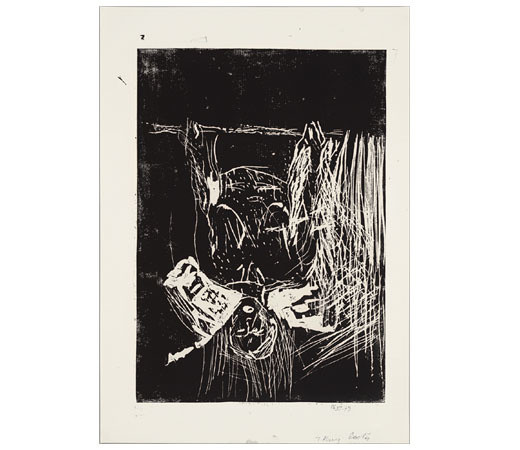
WENDY WEITMAN: Other sections of this exhibition deal with a variety of alternative art practices—from wallpaper, to artist’s books, free mailers and multiples. In this gallery, however, we return to the more traditional printmaking mediums of wood and etching. They too experienced a revival in the late 1970s and 1980s, as a renewed interest in exploring primal human forces and emotions emerged. Here, we have three versions of Woman at the Window, by German artist Georg Baselitz.
DEBBY WYE: This is a series of linoleum cuts. A linoleum cut is like a woodcut, but involves carving an image out of a piece of linoleum, as opposed to wood, before inking the block and printing it. These works, starting at the left, show the evolution of Baselitiz’s composition. He began with an upside-down woman at a window, but kept returning to his piece of linoleum and carving it further. Then, he’d make another print, so he could see his progress. Eventually-- as you can see in the third example here -- the composition became almost completely abstract.
WENDY WEITMAN: By the end of the process, the original figural composition is gone. The linoleum block that it was made from now has many additional marks on it, so there's no going back.