DEBBY WYE: Hello, I'm Deborah Wye and I'm the Abby Aldrich Rockefeller Chief Curator of Prints and Illustrated Books here at The Museum of Modern Art.
WENDY WEITMAN: And I’m Wendy Weitman, Curator of Prints and Illustrated Books. We’d like to welcome you to the exhibition Eye on Europe: Prints, Books and Multiples, 1960 to Now.
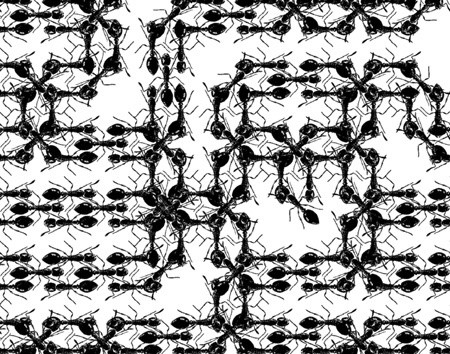
DEBBY WYE: This exhibition takes place on the sixth and on the second floors. In both places, you can’t miss the wallpaper as you enter. The artist is Peter Kogler, from Vienna. He's used ants as a motif in his work going back 25 years, starting with a super-8 movie he made.
PETER KOGLER TAPE: I was visiting friends in Italy, and there was a newspaper lying on the floor in the garden. And an ant was running over the page. So I made a little movie. In that movie, it looks like a letter would start to move.
WENDY WEITMAN: Austria, with its long tradition of decorative arts and crafts, is known for patterned wallpaper. Kogler tweaks this tradition by choosing a motif that’s edgy rather than conventionally pretty: the ant.
PETER KOGLER TAPE: It's ambiguous, I would say. I mean it has positive connotations. Like a kind of social component, or I don't know, work discipline, and of course, there's also kind of irritating aspect to it that could be scary.
DEBBY WYE: With this, we’re seeing the kind of alternative thinking about art that emerged in the 1960s. Abstract Expressionism, long dominant in America and Europe, was starting to feel devoid of new ideas, and artists began looking for inspiration in the everyday world.
WENDY WEITMAN: Europe had come out of a period of austerity, and popular culture was on the rise in magazines, television, and advertising. This outpouring of media engendered new ways of making art -- new techniques, new formats and new content, from books and multiples to printed ephemera. You’ll find them all in this exhibition.
DEBBY WYE: For detailed instructions on using this Acoustiguide, press 1-0-1 and the ‘play’ button at any time.