Curator, Terry Riley: This architectural model reverses our usual expectations. In 1989 it was entered in a design competition for the National Library of France by a Dutch firm called OMA, or the Office for Metropolitan Architecture, headed by Rem Koolhaas.
In a typical architectural model, the solids and spaces are small-scale replicas of the solids and spaces of the proposed building. Not here. Because a library is essentially a big stack of books, Koolhaas and his associates thought it most important to visualize the open areas around and between the stacks, where people circulate. So the solids you see in this model stand for the building’s open areas, while the walls, floors and the stacks themselves are left to your imagination.
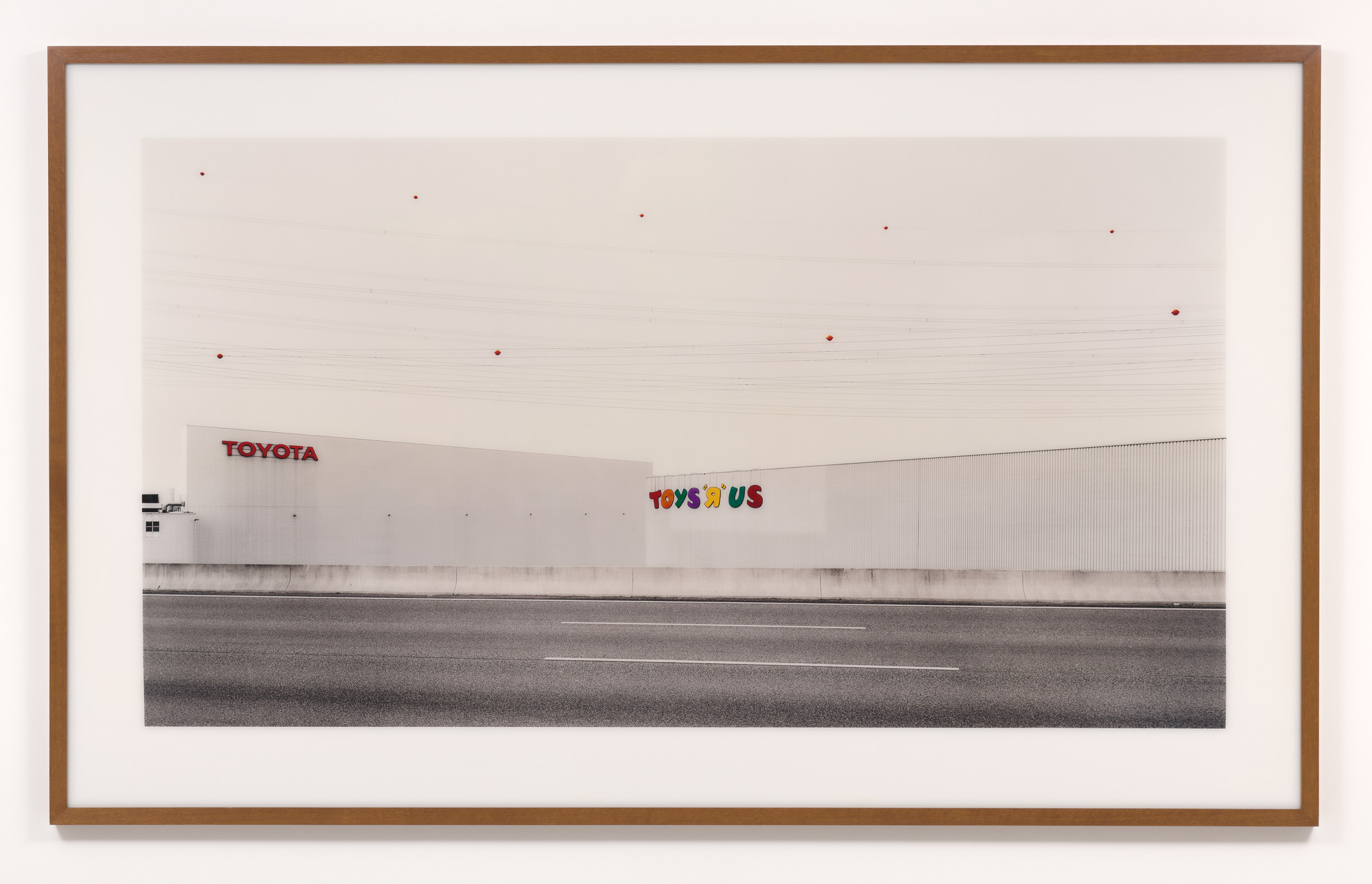
Koolhaas, an important critic as well as practicing architect, has written about the impact of very large buildings like this one on the physical and social environment. The ambiguous appeal of what Koolhaas calls the “phenomenon of bigness” is perfectly captured in a photograph by Andreas Gursky on the wall to your left, where two enormous warehouses in Dusseldorf, Germany, sit side by side, their blank exteriors distinguished only by international corporate logos.
Any hints at the types of consumer goods produced by these corporate giants are totally hidden. Such purely functional structures have been called “big dumb boxes.” Yet as aesthetic objects, they have an undeniable presence. Indeed, Gursky and Koolhaas both seem to be mesmerized by architecture on this overpowering scale.
Koolhaas recently commented on this image:
Architect, Rem Koolhaas: With all the naiveté, to be in close proximity to the picture, pictures of Andreas Gursky and particularly to Toyota and Toy "R" Us image, is a stunning image for me because it shows the utter brutality of the contemporary world, but also, the perverse forms of the sublime that can be found in it. I think it is a really harsh analysis of how the world works.
The world in architecture is now a number of fairly anonymous identical containers and the only difference is a difference of branding- Toyota and Toys 'R" Us –that both start with a "T", and that roughly have a kind a similar amount of letter. That both put a logo in the upper left corner, and it's in itself a kind of un-masking of architecture -- how the essential needs for place identity difference have been reduced to the really bare minimum. I cannot imagine apart form complete anonymity something more radically barren. And of course, if you see a picture like this, all the efforts of architects, and all the energies of architects directed at interest beauty identification and seem astonishingly old fashioned, superfluous, and redundant.