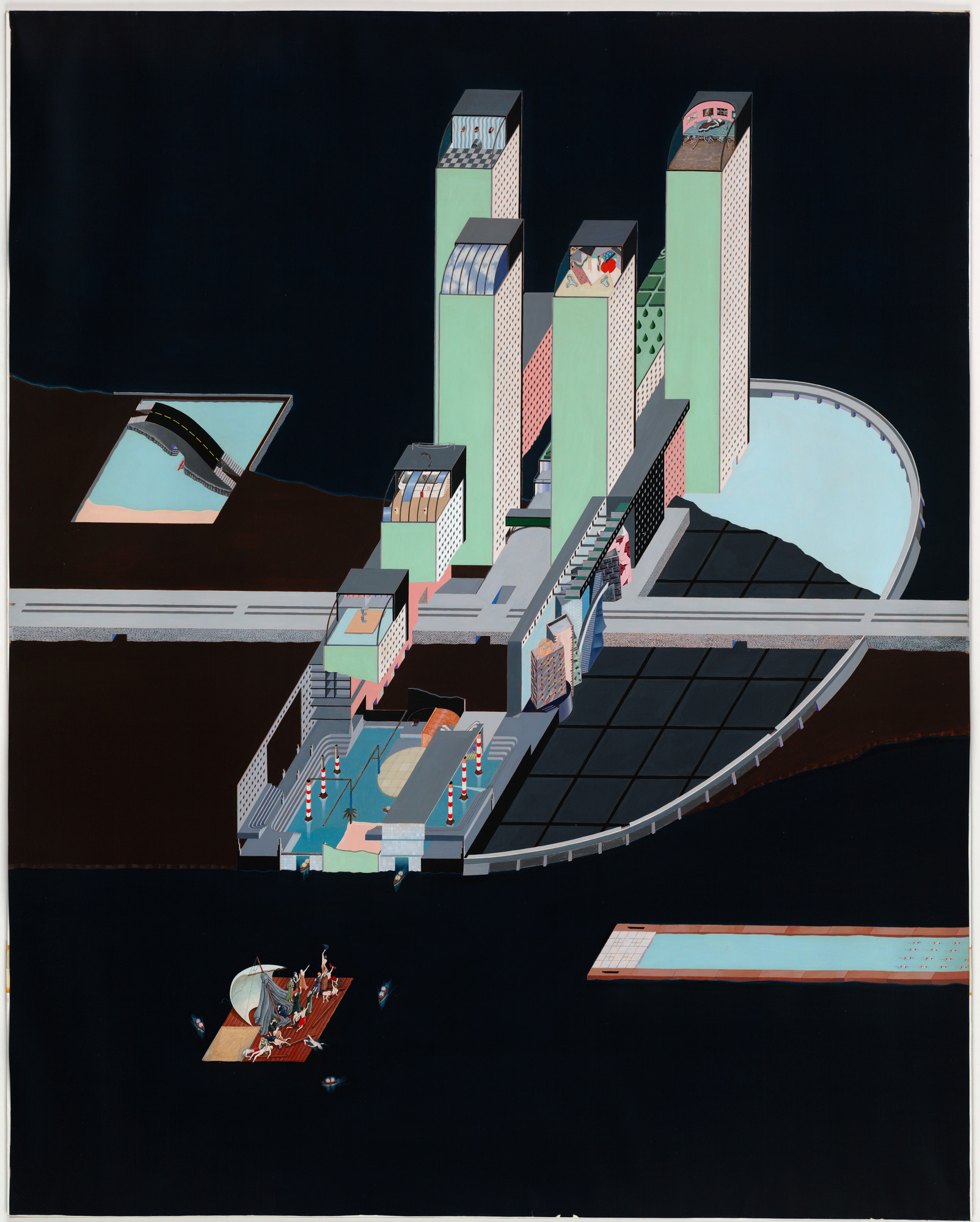
Rem Koolhaas: The mid-70's were the beginning of the first ramblings of post-modernism. There was a relentless critique of how boring modernism was. And I was sensitive to that critique and made a number of portraits. And I think the new Welfare Palace Hotel is perhaps the most tortured one, where I was looking at Manhattan for the first time and trying to answer the question whether architecture could be at the same time modern and interesting.
You notice that on the ground floor, there is a kind of night club on the theme of shipwrecks. I was immodest enough to believe that was at that time in appropriate metaphor for western civilization. You see, for instance, that there are very interesting tops and that the flank of the building has a kind of miniature sculpture of a crumbling city, which on my part was an attempt to force myself in a way to make interesting and appealing architecture.
My real heart in the entire picture is in the most neutral part, you will see in the lower right corner, a portrait for a swimming pool which was part of a story, where for me, the most radical form of modernism would be a simple rectangle of clean water floating in dirty water. And as you see, in this story it is a pool that was actually designed by Russian students in the 30's. And when the situation in Russia turned bad they used the pool to escape to New York. And the irony was that in order to get to New York, they had to swim the entire journey from Russia. Anyway, new Welfare Palace represents for me a highly confused moment, a moment where you can still tell on everything that my real loyalties are with a kind of hardcore neutral modernism.