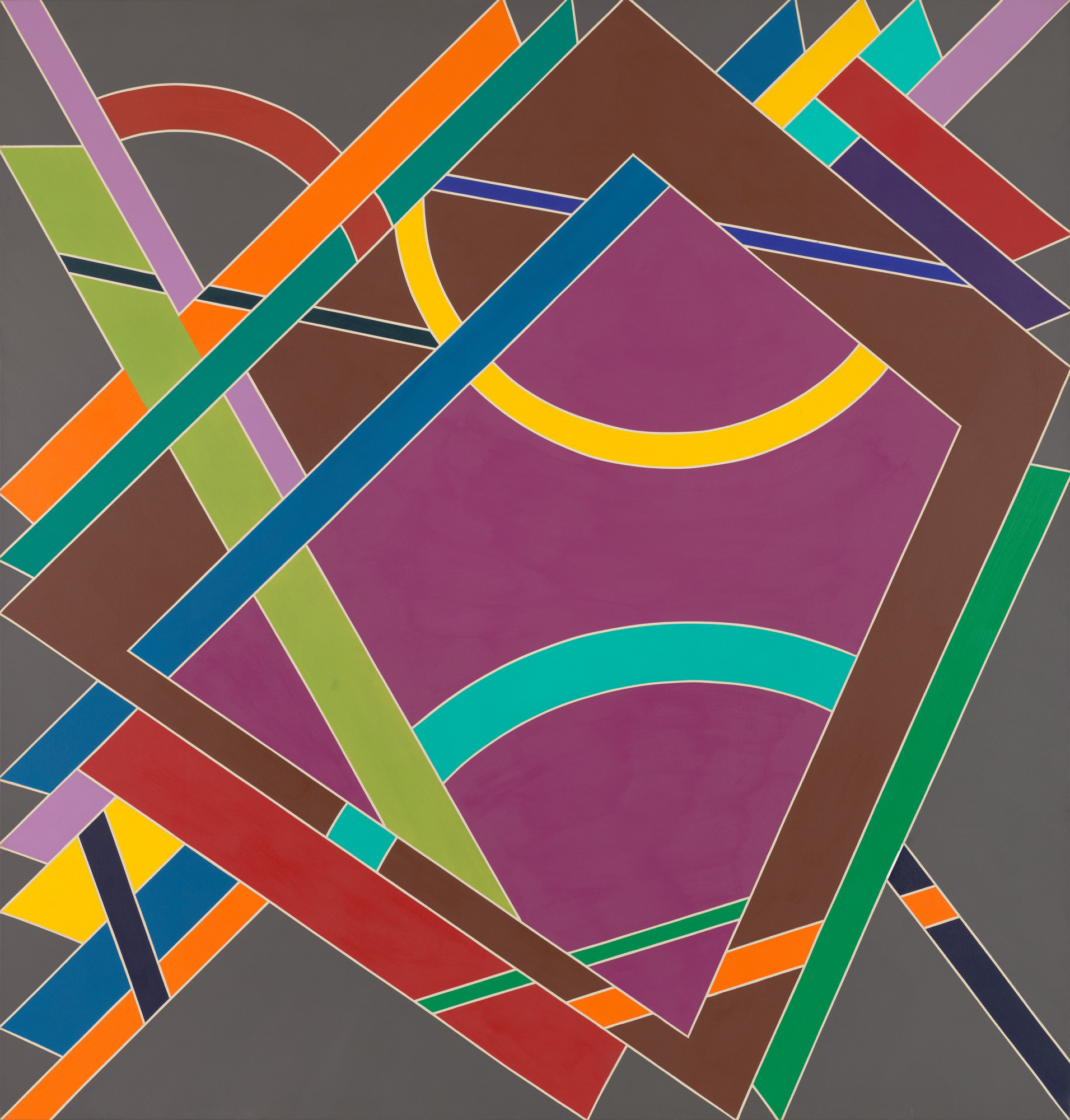
Artist, William T. Williams: My name is William T. Williams. At the time that I did this painting, I had just moved back to New York from graduate school. And I began to do a series of large scale paintings. And the large scale had to do with wanting to make a painting that had physical presence as well as a kind of an emotional presence. I wanted to make a painting that asserted itself with an extraordinary amount of color.
In the late '60's, most artists were not giving titles to paintings. And I didn't want the painting to be anonymous. Elbert Jackson was my grandfather.
A recurring image is a diamond. And the diamond is a diamond within a box. And that idea of touching the four corners of the rectangle was something that I had really become interested in, because it gave me an orientation. But it also gave me a way of creating tension within the painting immediately. There are lots of kind of small geometric incidents that are occurring. And then the play with the curvilinear forms in relation to that. The circular forms offer a relief to the severity of the geometry.
The lime green part, the kind of asymmetrical aspect, things are hinged to that. And that hinging quality is something that allows the painting to have a sense of movement. Sometimes in a painting you can place a form where it doesn't lock in. It doesn't hold its place. It has some potential of movement within a painting. That potential of movement sets up a kind of emotional anxiety that something is not at rest within the painting.