Walid Raad: On the right side of the corridor, facing the sculpture garden, the first thing you will notice are three walls. Each wall includes wallpapered black and white images of display cases. I looked at historical photographs of where Islamic art had been displayed in the 19th and 20th Century. And I layered all the display cases on top of one another, about 60 layers.
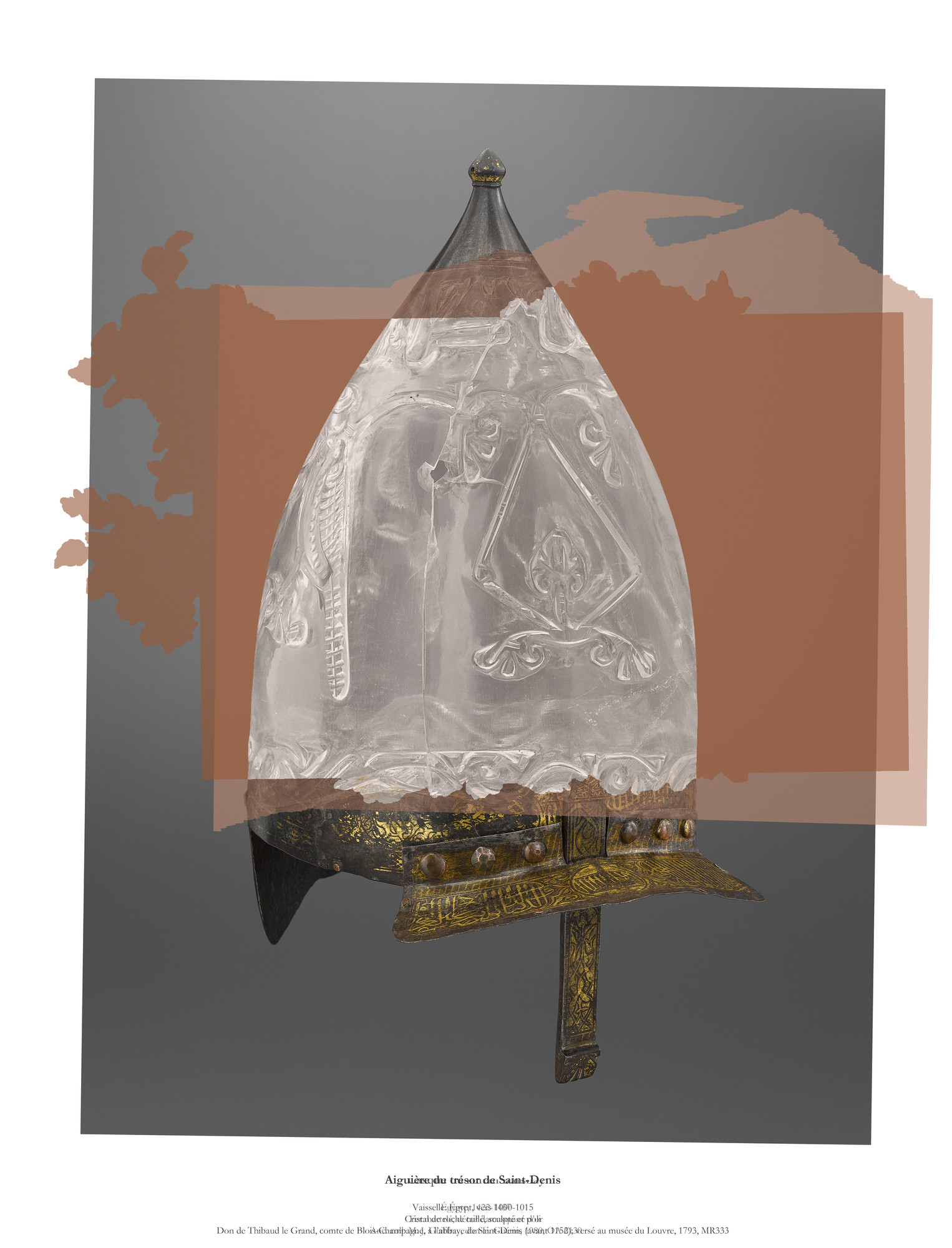
You will also notice that there’s a three dimensional object that is displayed. And it's a very odd object. It has some elements that are familiar to Islamic art, but not necessarily consistent with an object you might have seen before. It is quite detailed in its front, and somewhat flat on the sides and the back. It's as though it's a photograph that itself has become three dimensionalized.
So when I spent two years in the Louvre, especially looking at their collection of Islamic art, I was trying to think of how I related to the objects. Am I able to see them? Am I able to use them to produce an artwork? It's that experience with these objects, with these lines, colors, shapes, and forms, that shape the story that emerged.