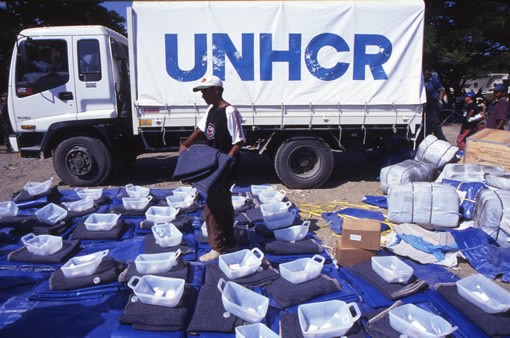
Director, Glenn Lowry: Sometimes the best design is the simplest. When large numbers of people are driven from their homes, simple plastic sheeting can provide quick emergency shelter.
Bernard Kerblatt is chief of the Emergency Preparedness and Response Section for the United Nations High Commissioner for Refugees. He says that refugees themselves were responsible for what has become a standard relief item.
Bernard Kerblatt: Way back in Thailand, in the late '70s, during the Indo-China tragedy, when masses of Cambodians, Laotians, Vietnamese were coming out from their countries to seek asylum we observed that they were spontaneously using small pieces of plastic sheeting that refugees could acquire on local markets. That's where the idea was born.
The idea is basic protection against the elements for human beings in a very precarious situation. We also discovered that the resourcefulness of refugees almost knew no limit. They also knew how to use plastic sheeting to collect rainwater. We also discovered very quickly that a piece of plastic sheeting with two pieces of bamboo poles can be used to make a stretcher. We could use also plastic sheeting to wrap up the bodies and to help people, communities, to offer a decent burial to their beloved one.
We maintain central emergency stockpiles, primarily in Copenhagen, and another one of a smaller size in Dubai, in the Gulf, to meet the needs of 500,000 refugees. These supplies are usually air lifted. That goes along with the principles of the deployment of emergency teams for which I'm responsible, who are scheduled to respond to any emergency call within a 72 hour period.