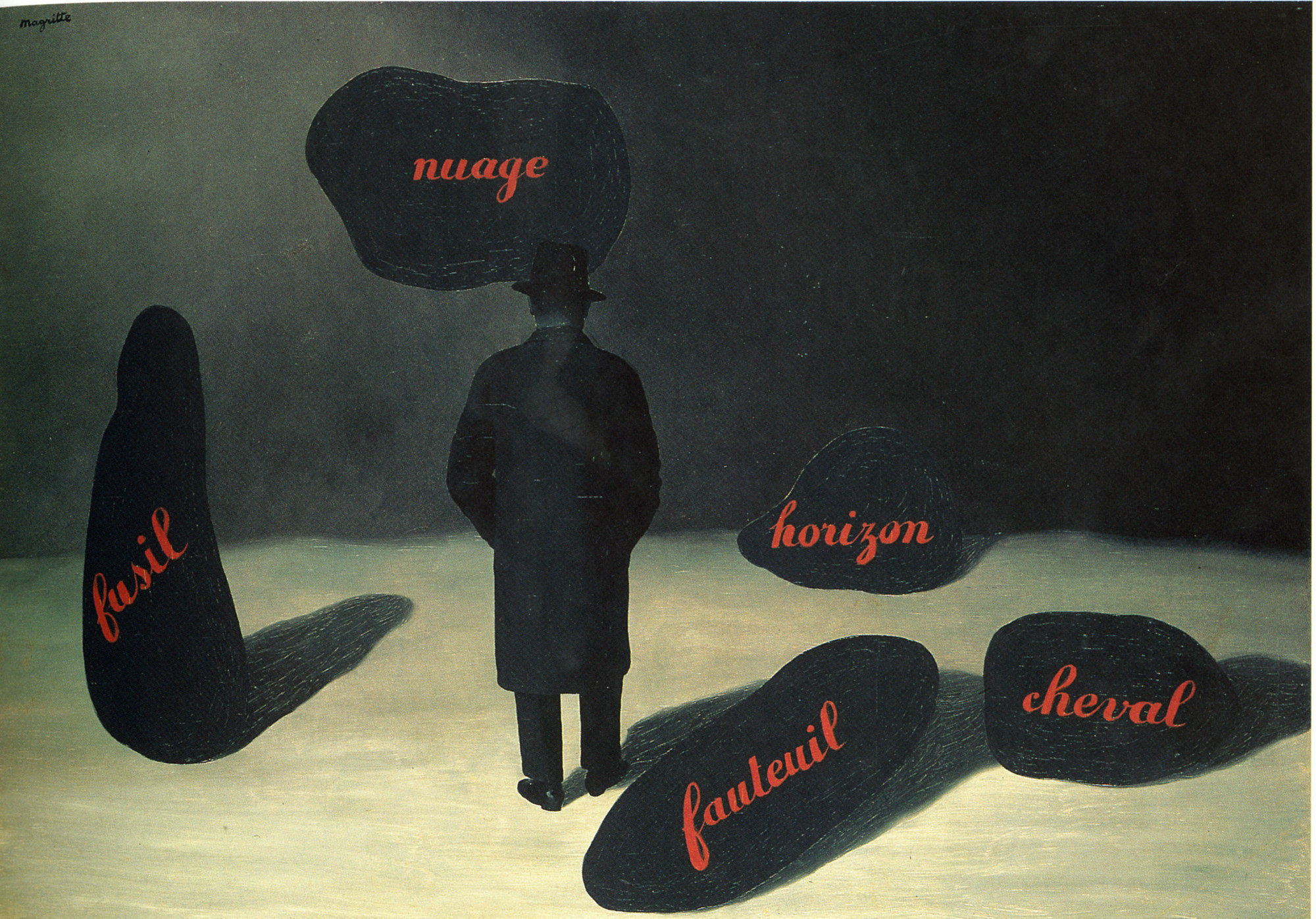
Narrator: In the fall of 1927, Magritte left Brussels for Paris, the center of Surrealism. There he began a sustained investigation of the relationship between text and image.
Director of the Menil Collection, Josef Helfenstein: Magritte's goal, which goes hand in hand with the Surrealist’s aim, is to liberate the mind, to undo the prison that language and image have been put in.
Narrator: In this painting, the French word _nuage_—or cloud—appears above the head of a solitary figure, where a cloud might be in a landscape. Horizon marks the horizon line. However, the remaining three words don’t follow the logical relationship between text and image. They are fusil or rifle; fauteuil—armchair; and cheval—horse.
Josef Helfenstein: It's really painting as a tool for thinking. And I think this is an important element of Magritte and actually the whole Surrealist movement. They just wanted to undermine this notion that art is a tool for pleasure, be it retinal, be it visual, or be it emotional.