Artist, Helen Frankenthaler: I feel, essentially, that I am a painter and involved in paint, per se, and the beauty of paint.
Curator, Samantha Friedman: Around 1962, Frankenthaler transitioned from oil paint to acrylic, which was partially responsible for a new emphasis on shape—forms with more defined boundaries.
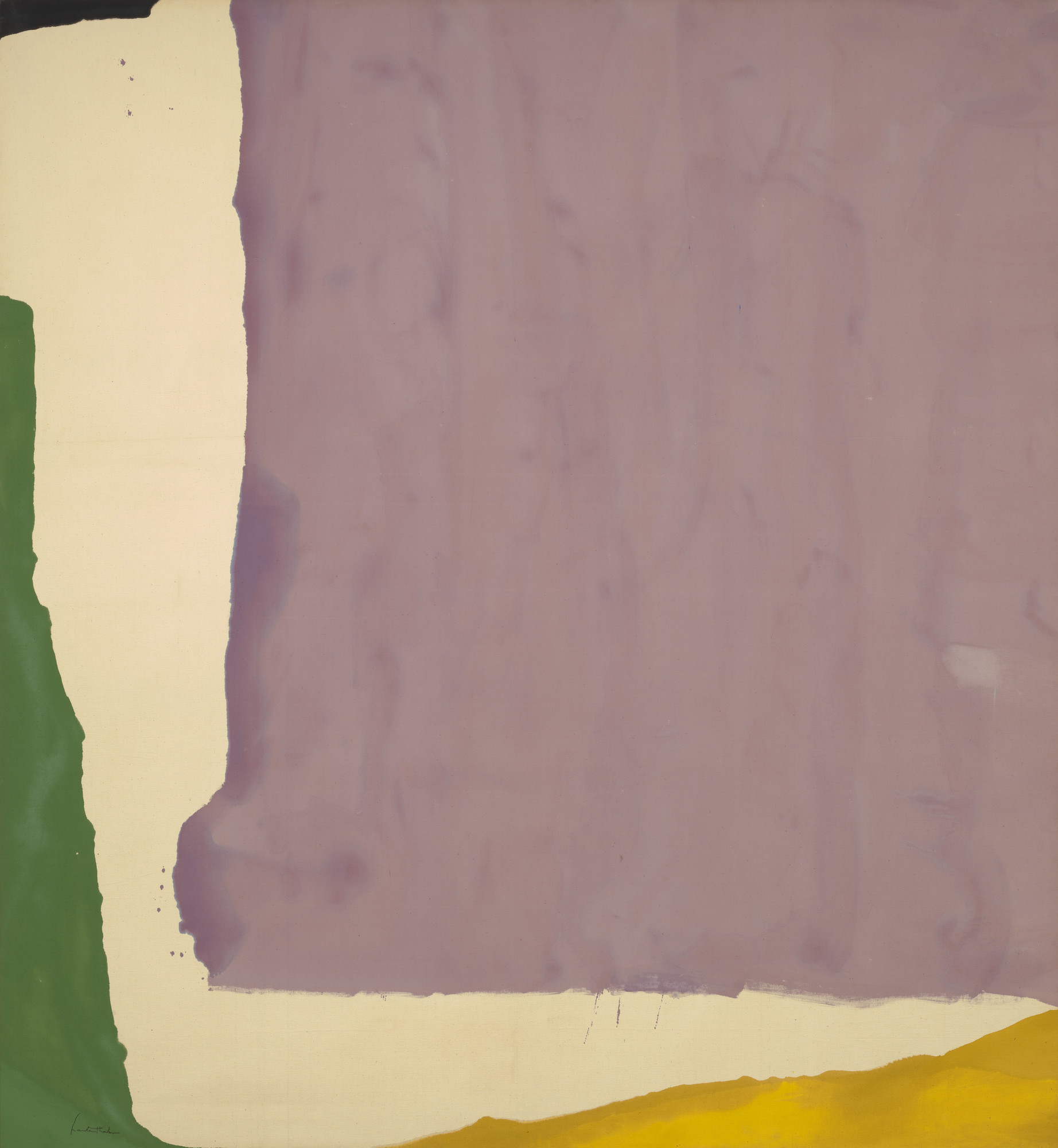
Speaking about Mauve District, Frankenthaler described how the dominant mauve form in this painting, a square, is a play on the very shape of the canvas. But when you look more closely, you see how much variation there is within the shapes. At the lower left, a little protrusion takes it off its geometry, and then these drips.
Helen Frankenthaler: Over the years, I’ve done different things with corners, either using them or ignoring them or pretending they’re not corners. At other times, feeling I want edges and limits.
Samantha Friedman: She always experiments with materials. I think that experimentation is what propels her work throughout so many decades. It’s that constant innovation that makes her work true to herself and not only the style of a moment in which she came up.
Helen Frankenthaler: One can’t plan how work is going to go, because that’s part of the beauty of it. I think anything original is as much of a shock to the artist as anyone else.
Archival audio from: Ruth Fine and Robin Thorne Ptacek. Interview about Helen Frankenthaler with Ruth Fine, This Week at the National Gallery radio series, 1993 April 11. Ruth Fine papers, 1929-2016; Oral history interview with Helen Frankenthaler, 1968. Archives of American Art, Smithsonian Institution; and Oral History with Helen Frankenthaler, Interviewed by Joseph Dorman, February 9, 1995. Columbia Center for Oral History, Rare Book and Manuscript Library, Columbia University Libraries.