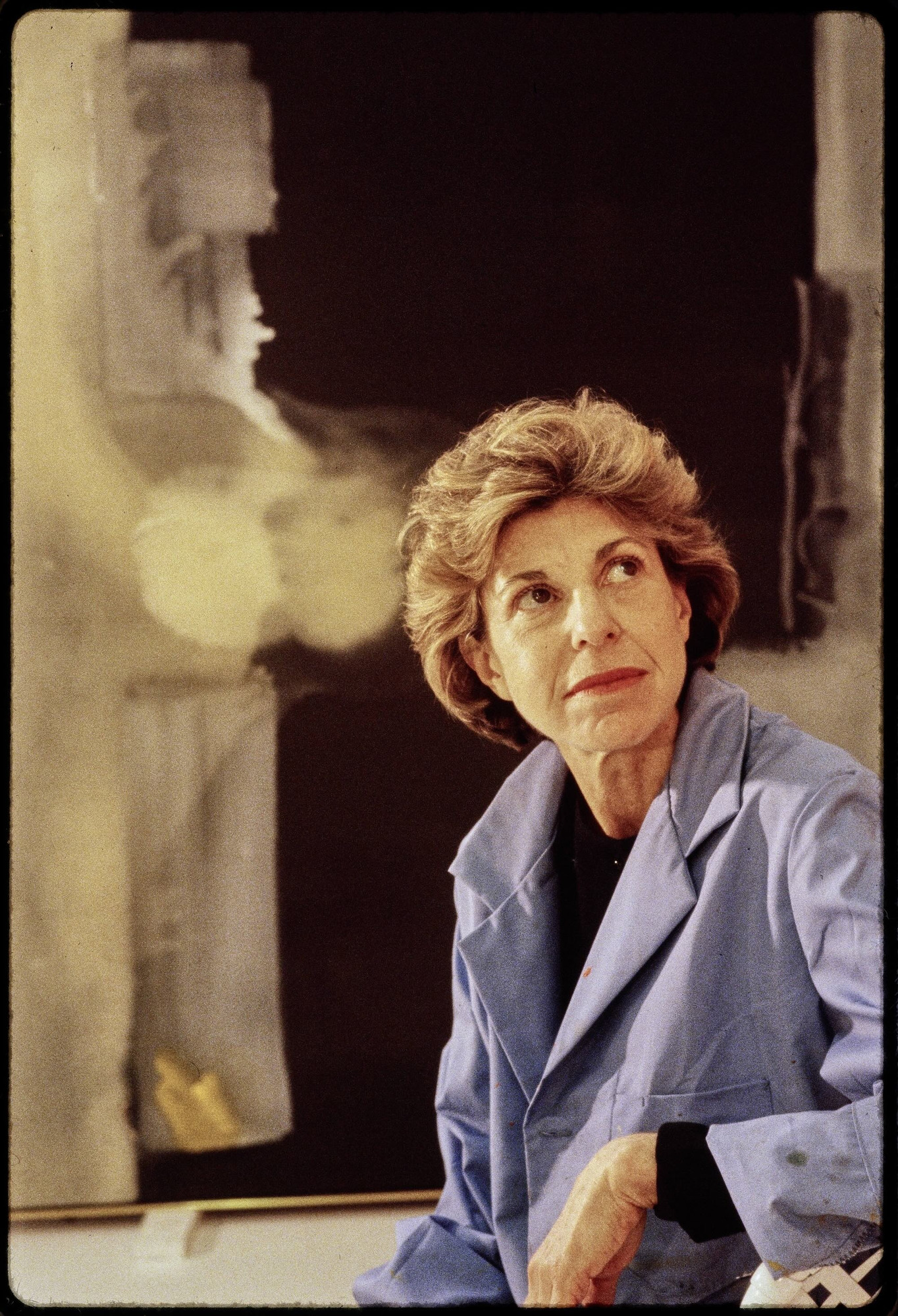
Artist, Helen Frankenthaler: It’s the result I care about. Do I like it? Does it work? Is it beautiful? Do I want it? Does it give me pleasure? Does it grow?
Curator, Samantha Friedman: I’m Samantha Friedman. I’m a curator in the Department of Drawings and Prints here at MoMA. And that was Helen Frankenthaler speaking in a past interview.
Helen Frankenthaler is associated with Abstract Expressionism, the painting movement in the 1950s. She developed her signature style, the so-called “soak-stain” technique. She applied thinned oil paint onto raw, unprimed canvas, so that it soaked directly into the fibers of the support.
Helen Frankenthaler: It’s a kind of marrying the paint into the weave of the canvas itself so that they become one and the same.
Samantha Friedman: Her approach really paved the way for a style of painting known as “color field painting,” which featured large expanses of flat color. You’ll see high-key oranges, dusty mauve and muted aqua, modulations of black or ochre. So I would encourage you to think about color as you look around the installation.
This exhibition is a kind of mini-retrospective. She’s experimenting and innovating in ways that really distinguished each phase of her career. And yet, her body of work also offers a continuous arc.
Helen Frankenthaler: I had to develop my own technique. The making of them, controlling them, and the surprise from them is a gesture that I do best, feeling that the edges can spread and that I can manipulate the paint and the sides—drawing, spilling, staining, tending—with much more reach and fewer limits.
Archival audio from: Oral History with Helen Frankenthaler, Interviewed by Joseph Dorman, February 9, 1995. Columbia Center for Oral History, Rare Book and Manuscript Library, Columbia University Libraries; and American Art in the 1960s. 1972. United States. Directed by Michael Blackwood. Courtesy Michael Blackwood Productions and Benjamin Blackwood