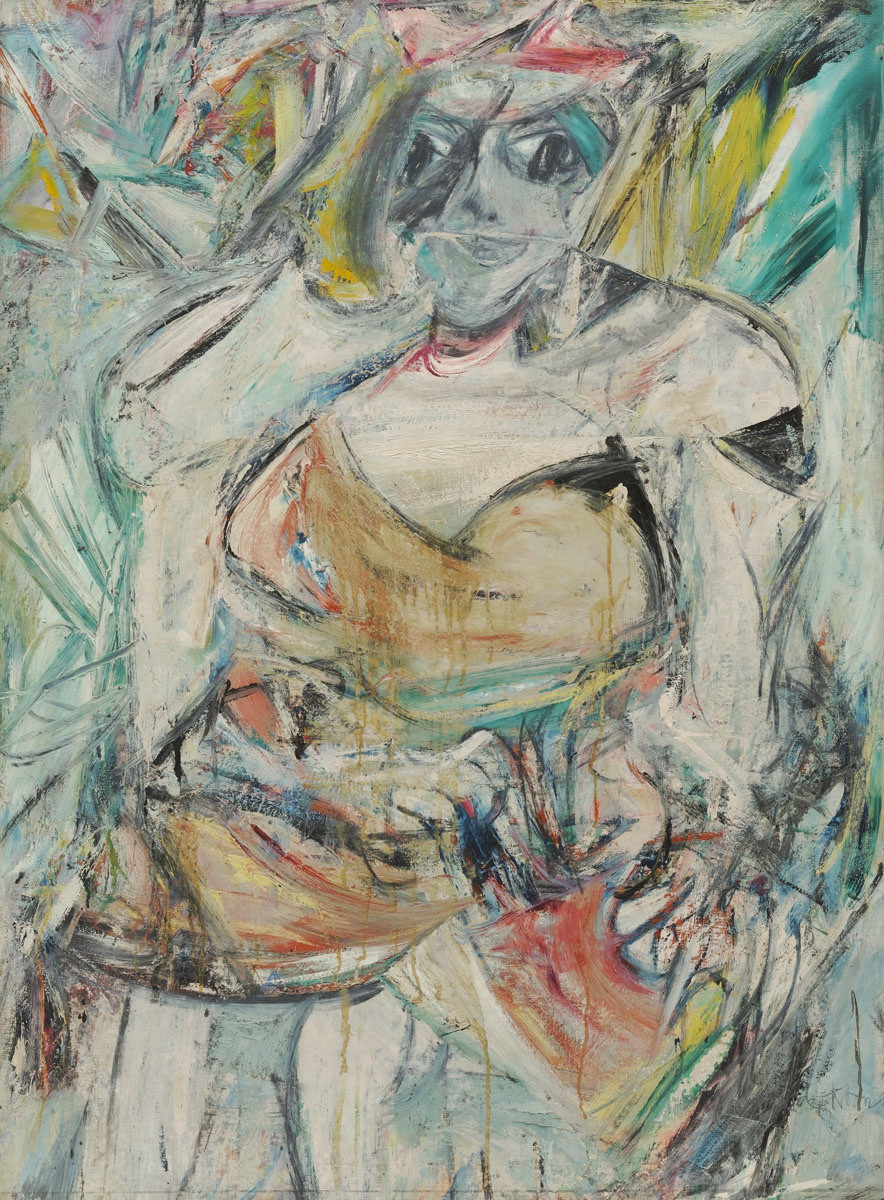
Narrator: De Kooning's Woman series from the 1950s was characterized by extensive reworkings of his canvases and experiments with surface texture.
Conservator, Jim Codington: One of the things that can be seen on Woman, II is de Kooning's use of collage to test compositional elements. There are a few pinholes on the far right center where it is clear de Kooning pinned some sort of a collage element, possibly to test a drawing on the surface of the canvas.
Narrator: On the far left side of the canvas, you can see chunks of charcoal embedded into the paint. This is where de Kooning drew directly onto the canvas while the paint was still wet.
Jim Coddington: One of the most distinctive features on Woman, II are the long brown drips that fall from the figure's chest. These are the result of de Kooning having put a heavily solvent-laden mixture into this area and simply letting it drip down through the underlying paint layers. Woman, II was done on a canvas that was not stretched as he worked on it. Along the bottom left edge, one can see a series of staple holes which indicate that the painting was stretched temporarily to test a slightly smaller composition.