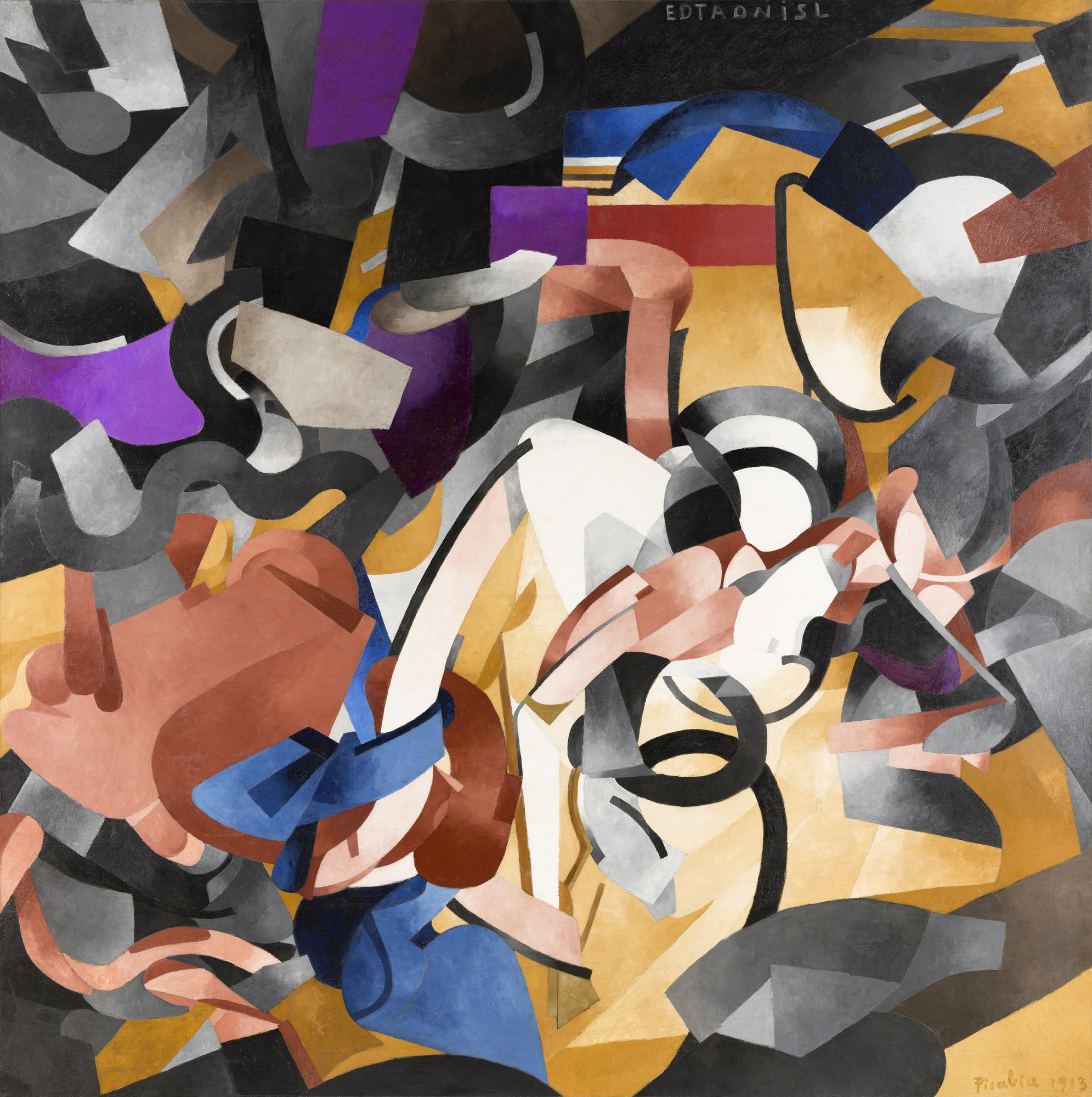
After his return to Paris in the summer of 1913, Picabia began working immediately “with a feverous, unimaginable rapidity,” as his wife Gabrielle Buffet-Picabia later recalled, “night and day, without eating.” The resulting canvases included the paired, magisterial abstractions Edtaonisl (ecclésiastique) (Edtaonisl [Ecclesiastic]) and Udnie (Jeune fille américaine; danse) (Udnie [Young American Girl; Dance]). The word Edtaonisl was Picabia’s invention, made by alternating the letters of the French words étoile (“star”) and danse (“dance”), without the final “e.” With the parenthetical ecclésiastique, Picabia signaled the painting’s connection to his transatlantic crossing earlier that year, during which he had observed a Dominican priest captivated by sight of a French dancer rehearsing on the ship deck.
Flirting with narrative in its title, the monumental abstraction gestures at the themes of dance and desire, as the brightly colored ribbons of paint tangle together to create a dynamic and charged spatial experience. Violet and ultramarine patches of color coil over gunmetal greys and golden ocher, creating a sense of vertiginous movement, which seems to both circle in on itself and widen past the borders of the canvas. Describing this work and Udnie in an interview that December, Picabia called them “memories of America, evocations of over there which, subtly set down like musical chords, become representative of an idea, a nostalgia, a fleeting impression.”
Edtaonisl was displayed alongside Udnie at the Salon d’Automne in November 1913, hung in a staircase landing that allowed viewers to approach the paintings from different heights and angles. As with the previous year’s submissions, these were relentlessly mocked by critics, who found them “devoid of sense.” Only Apollinaire praised Picabia’s recent abstractions, calling them “ardent and lyrical.”
For Allison Langley’s essay on Edtaonisl (écclesiastique), see mo.ma/picabia_conservation.