|
|
|
|
|
|
|
|
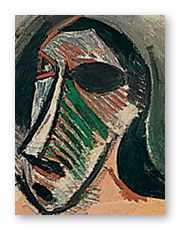
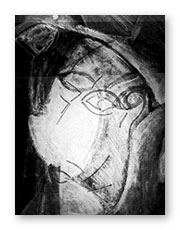
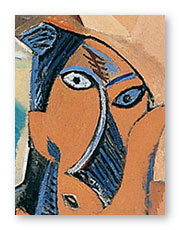
X-rays of Heads
Details
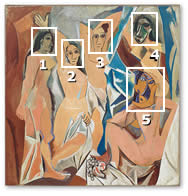
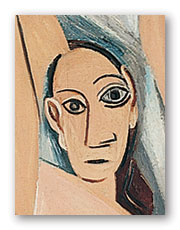
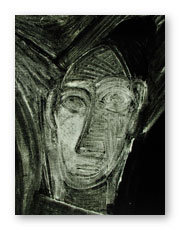
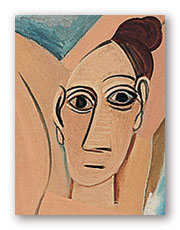
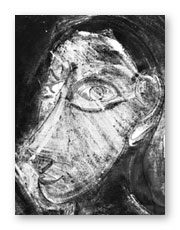
of the heads of the five
figures, paired with their
corresponding X-ray details, are described from left to
right (above) starting with the curtain-pulling
figure (Fig. 1) and ending with the
crouching figure (Fig. 5). The right
figures (Fig. 4 and Fig. 5) also have
tracings that indicate earlier compositional
features.
Pictured above:
Pablo Picasso.
Les Demoiselles d'Avignon.
1907. Oil on canvas, 8' x 7' 8"
(243.9 x 233.7 cm). Acquired through
the Lillie P. Bliss Bequest. ©
2003 Estate of Pablo Picasso/Artists
Rights Society (ARS), New York
|
|
|
|
|
|
|
|
 |
|
|
Fig. 1-Curtain-Pulling Figure
(far left of painting)
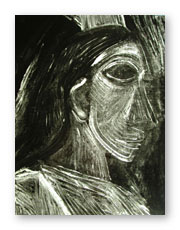
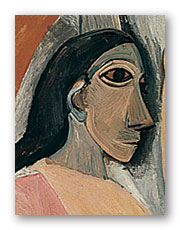
The
heavier paint application is evident here in
the outline of the jaw and shoulder, where Picasso
delineated forms using thicker paint with some
lead white mixed in. Darkly pigmented areas
such as the hair and background are composed
mainly of earth pigments, which are transparent
to the X-rays
and appear as dark passages on the X-ray film.
With close examination, the weave of the original
canvas can be discerned in these thinly painted
areas. No major changes to the composition of
this figure are evident in the X-ray.
|
| |
|
|
Fig.
2-Iberian Figure
(center left of painting)
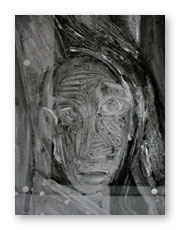
This central figure also represents
the initial overall composition of the heads influenced
by Iberian sculpture. Most notable in this figure
are the prominent ears and wide, staring eyes.
The right eye is particularly densely painted
due to the lead white impasto.
This X-ray was taken after the stretcher was replaced
in 1963. This is evident in the lighter borders
caused by the wooden stretcher bars on the left
and lower edges. The white circular areas correspond
to screws reinforcing the stretcher bars. |
|
|
Fig. 3-Iberian Figure
(center right of painting)
The X-ray image of the right central
figure is similar to Fig. 2, suggesting that this
central pair were painted with very little alteration,
in contrast to the two figures on the right. Note
the slightly thicker application here. |
| |
|
Fig. 4-Figure Derived from African
Mask
(top right of painting)
Picasso's
reworking of this head is especially evident
in the large ear that appears in the X-ray,
but is painted over in the final version. This
ear, no longer visible, is painted in similar
fashion to the ears of the Iberian heads discussed
in Fig. 2 and Fig. 3. Picasso also transformed
the formerly petite nose into a massive wedge
shape and repositioned the mouth into a long
chin and jaw outlined in black. At an earlier
stage the right eye contained a staring pupil
that is now painted black.
Evidence of all these changes—nose,
eyes, and chin—are emphasized in a tracing
of the underlying composition that bears a close
resemblance to the heads of the central figures.
Picasso's slashing brushwork of parallel red
and green paint is also visible in the X-ray.
This is the same type of paint application he
used in the heads of the central pair, made
much more bold here by his choice of complementary
colors.
|
| |
|
Fig. 5-Crouching Figure
(bottom right of painting)
The
cubist head of the crouching figure underwent
at least two revisions, with an intermediate
stage having a bright yellow complexion. The
first composition, close in appearance to the
central Iberian heads, can be seen where an
eye stares out from beneath the bridge of the
nose. A tracing over the X-ray indicates this
third eye and some other contours. The next
campaign on this figure included the extensive
layer of cadmium yellow seen in visible light
through cracks in the final paint layer. The
cadmium yellow layer adds another level of density,
resulting in the most opaque X-ray image of
any of the figures.
|
|
| |
|