
|
Konstantin Akinsha, Alexander Roitburd, and Mikhail Rashkovetsky of the Soros Center for Contemporary Art have assembled "deep" European artists, curators, and critics for an art talk conference. The topic is "East and West: The Problem of Cultural Incomprehensibility." No incomprehension is evident among the participants. |
"Academism rules contemporary art," say the artists. | |
| They bemoan the need to write grant proposals, e-mail CVs , negotiate contracts, and follow a conventional formula. Artists don't take well to rules, and they leave no one in doubt about their frustrations. |
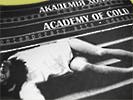 Exhibition poster Academy of Cold (click image for enlarged view)
|
| If art is destined to expire, Roitburd believes that artists must be active participants in their suicide. | Concurrent with the conference, ALEXANDER ROITBURD organized the exhibition, Academy of Cold. In his role as curator, Roitburd sought works of "simulated" artistic gesture. He wished to annihilate the creative impulse. Thus he would demonstrate loyalty to "the realities of the art situation." |
|
Installation (detail)
(click image for enlarged view) 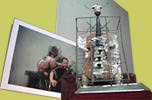
|
"Alas," Roitburd smiles, "I am also an artist, and my creativity would not die." So curator Roitburd happily capitulated, and the Academy of Cold got hot. |
| The Russian director Sergei Eisenstein secured the renown of an Odessa landmark. Every aspiring filmmaker has studied the Odessa Steps sequence in the film Battleship Potemkin. The sailors and people revolt, whereupon the Czar's soldiers advance down the steps, rhythmically massacring the population. | Roitburd's Psychedelic Invasion of the Battleship Potyomkin into Sergei Eisenstein's Tautological Hallucination is a complex postmodern layering of Social Realism, Surrealism, and madness. |
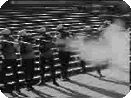
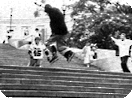
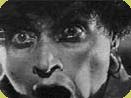 The installation includes a video of the Odessa Steps sequence modernized. Roitburd's skillful montage would make Eisenstein proud, or cringe. Intercut with the original material are shots of a roller-blader, a hybrid from Planet of the Apes, a Matthew Barney satyr, and the artist on a violin.
 From installation Odessa Steps (4:17 min. RealVideo clip.) From installation Odessa Steps (4:17 min. RealVideo clip.)
|
|
| The painter Kandinsky is a native of Odessa. The local people, who are fixated on figurative art, paid him little attention until Roitburd organized the exhibition, Kandinsky Syndrome. | |
|
|
The title of the show derives from a medical condition investigated by Kandinsky's uncle, a psychiatrist. The malady entails a peculiar loss of identity: The sufferers believe that they act at the order of external commands, not of their own volition. |
| Roitburd draws parallels between the Kandinsky Syndrome and "the art situation." "A full understanding of the connections," Roitburd acknowledges, "requires psychiatric consultation." | |


|

|