1958
- Rome, Italy: March 1–30, 1958 MAP
- Basel, Switzerland: April 19–May 26, 1958 MAP
- Amsterdam, the Netherlands: June 6–July 7, 1958 MAP
- Hamburg, Germany: July 19–August 21, 1958 MAP
- Berlin, Germany: September 1–October 1, 1958 MAP
- London, England: November 5–December 7, 1958 MAP
- Paris, France: January 16–February 15, 1959 MAP
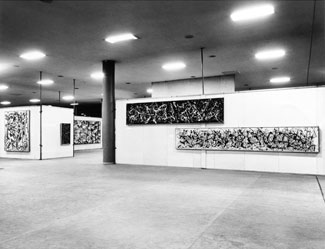
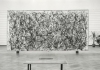
In response to requests from European museum directors, Jackson Pollock 1912–1956 toured throughout Europe after being shown at the IV Bienal do Museu de Arte Moderna, São Paulo, in the summer of 1957. The retrospective was shown alongside The New American Painting in Basel, Berlin, and Paris. Frank O'Hara, guest curator, extracted work from the Museum's 1956 Jackson Pollock exhibition, including thirty-one early and late paintings and twenty-nine drawings and watercolors.
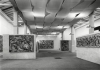
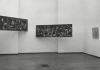
Local curators installed the show at each location and responded inventively to the challenges of hanging the mural-sized canvases. In Rome, curator Giovanni Carandente installed several works in doorways or wrapped around corners of the Galleria d'Arte Moderna. Canvases were suspended from wires and planted in the ground, transforming them into distinct walls and windows. Bryan Robertson and Trevor Dannatt, the respective director and architect of London's Whitechapel Art Gallery, draped fabric across the ceiling and walls to soften the backdrop for the paintings. What Sam Hunter, associate curator in the Museum's Department of Painting and Sculpture, referred to as Pollock's "autonomous and sovereign artistic reality, powered by its own dynamism, monumental in its scale and breadth of feeling" demanded new methods of display.