As Lawrence predicted, the Great Migration continued long after he finished his series. Southerners found new reasons to leave their homes after World War II, as renewed economic growth added thousands of jobs to the payrolls of major industrial companies in the North and West. In the following decades, the continuing migration transformed the nation’s racial composition. In 1900, only eight percent of the country’s African-American population lived above the Mason-Dixon Line; by 1970, forty-seven percent of black Americans lived outside the South. The Migration’s momentum abated only after the watershed cultural and legal reforms of the civil rights era began to take effect in the South; they ameliorated the segregation of public accommodations and schools as well as restrictions on voting and other civil liberties, and they opened new paths to economic opportunity. But the accomplishments of community leaders, student organizations, politicians, and other advocates of racial equality in the 1950s and 1960s would in many ways have been unthinkable without the example set by the millions of black migrants in previous decades. By leaving their homes, black southerners collectively took a stand against the racial discrimination that had plagued their communities for centuries.
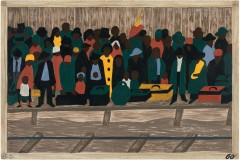
And the migrants kept coming.
And the migrants kept coming.
- 1941 caption
- 1993 caption
- Close
Two sets of captions accompany Lawrence’s Migration Series: the original 1941 texts and a revised version he wrote in 1993 for a tour of the series organized by The Phillips Collection, Washington D.C. Click on each date to compare the two.

And the migrants kept coming.
And the migrants kept coming.
- 1941 caption
- 1993 caption
- Close
Two sets of captions accompany Lawrence’s Migration Series: the original 1941 texts and a revised version he wrote in 1993 for a tour of the series organized by The Phillips Collection, Washington D.C. Click on each date to compare the two.
In the last panel of the Migration Series, Lawrence returns to the motif of the train: this time a crowd of anonymous black figures fill a railroad platform. Packed shoulder to shoulder across the width of the panel, the migrants stand with their bags and suitcases, waiting to pile into the next train. The series ends on an elliptical note: the rush of black southerners into the North, Lawrence suggests, will continue well into the future.
History
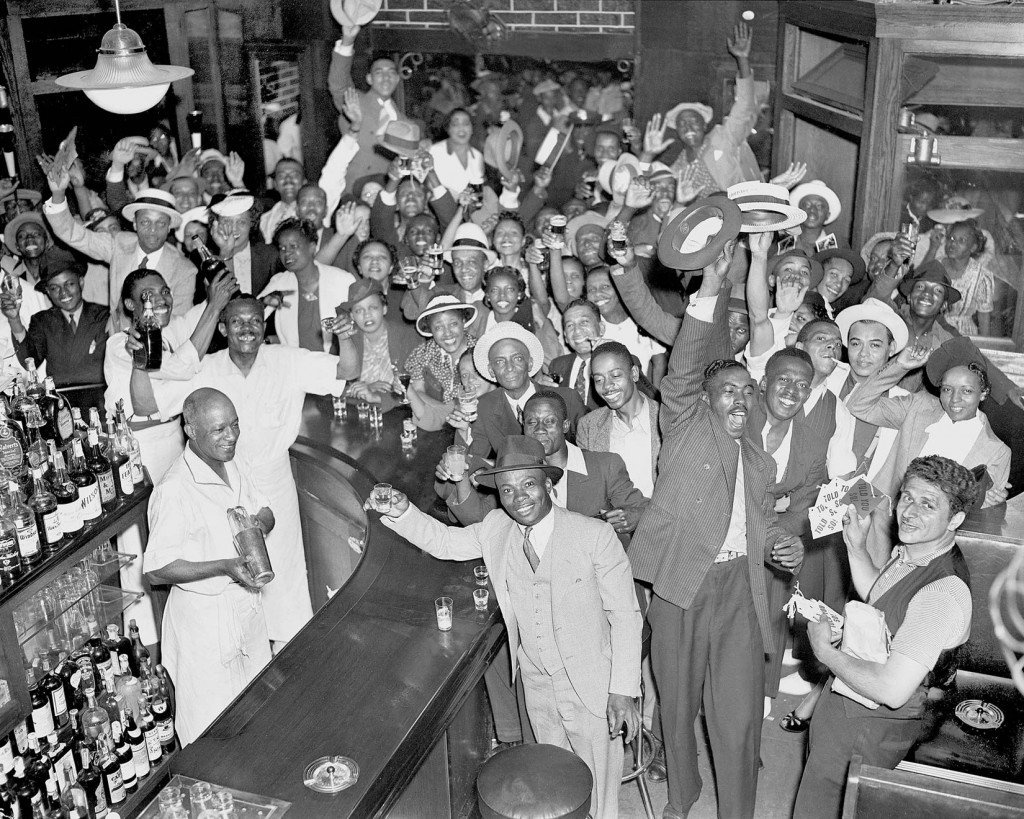
Patrons at a Harlem bar on 135th Street toast joyously after black world heavyweight champion Joe Louis’s first-round knockout of Max Schmeling at Yankee Stadium, 1938
Culture
Poetic in its brevity and evocative tone, Lawrence’s short caption to this panel brings to mind Sterling Brown’s 1931 poem “Strong Men,” an homage to the resilience of African Americans after centuries of oppression. Brown writes:
They cooped you in their kitchens,
They penned you in their factories,
They gave you the jobs that they were too good for,
They tried to guarantee happiness to themselves
By shunting dirt and misery to you. …Today they shout prohibition at you
“Thou shalt not this”
“Thou shalt not that”
“Reserved for whites only”
You laugh.One thing they cannot prohibit—
The strong men … coming on
The strong men gittin’ stronger.
Strong men…
Stronger…
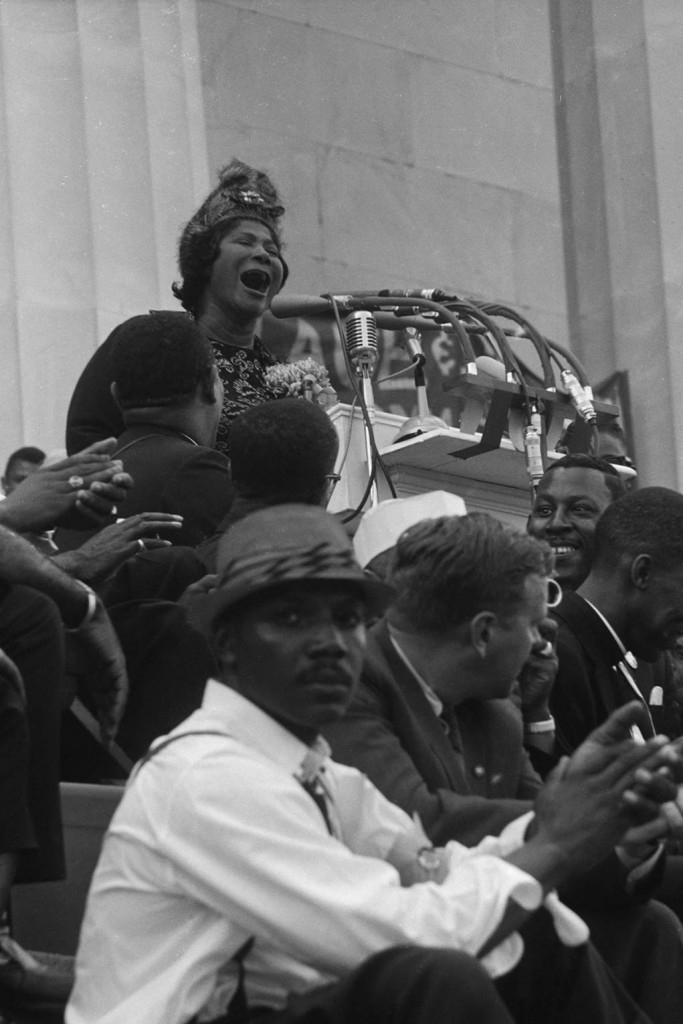
Mahalia Jackson singing in front of the Lincoln Memorial at the March on Washington for Jobs and Freedom, where Martin Luther King, Jr., gave his “I Have a Dream” speech, August 28, 1963
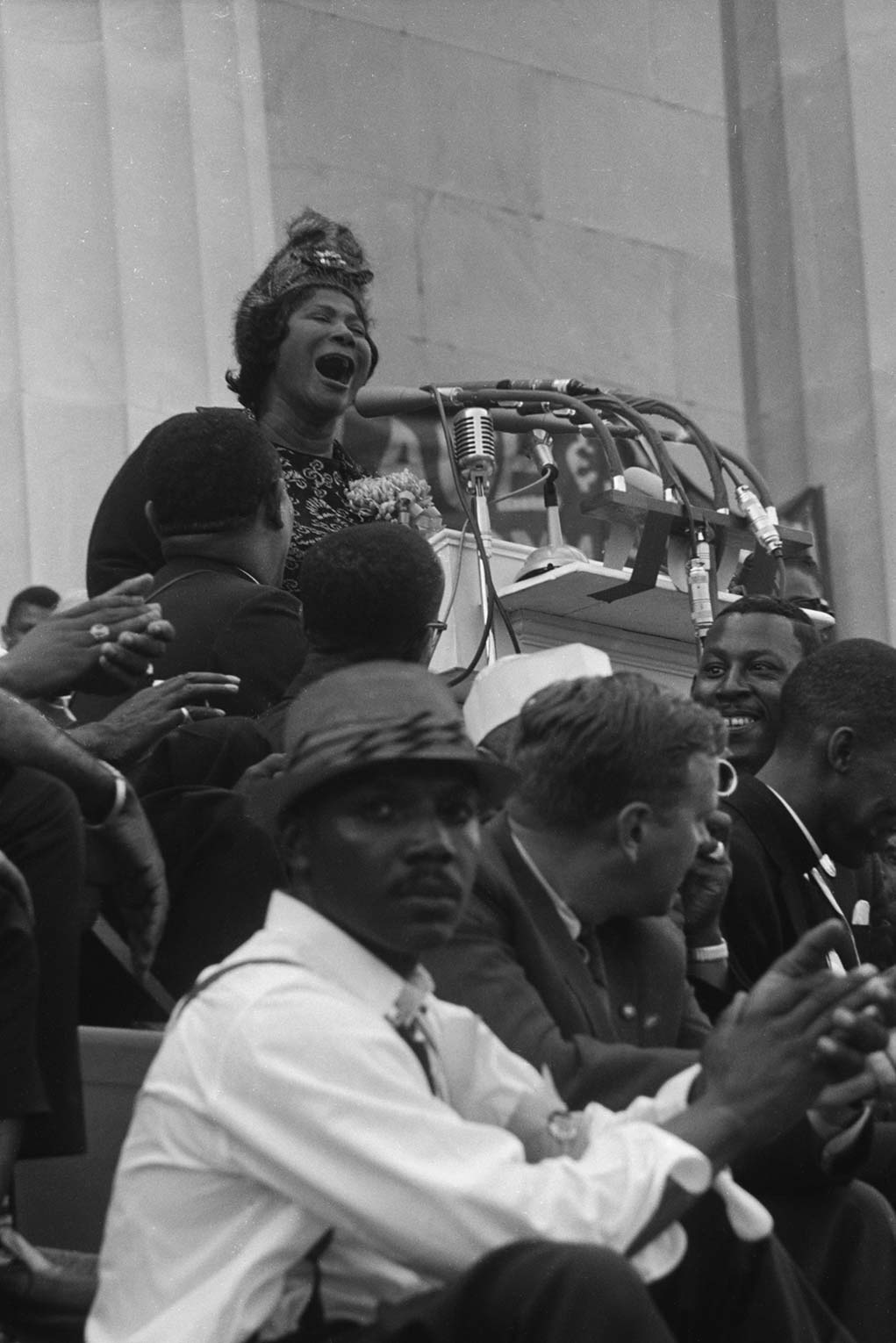
Perseverance is also the theme of one of the most popular gospel songs of all time, “Precious Lord, Take My Hand,” written by Chicago gospel pioneer Thomas A. Dorsey in the mid-1930s. This song was likely first recorded by the Heavenly Gospel Singers in 1937; the languid a cappella delivery in that version is characteristic of an earlier style of gospel music. The song was later performed by powerhouse singers of the newer gospel style like Sister Rosetta Tharpe and Aretha Franklin, but Martin Luther King Jr.’s favorite version was that sung by Dorsey’s protégé, Mahalia Jackson. King often invited Jackson to sing the song at civil rights rallies, where its lyrics, which convey weariness along with resolution to complete the journey, resonated strongly. Jackson sang the same lyrics at King’s funeral in 1968:
Precious Lord, take my hand
Lead me on, let me stand
I am tired, I am weak, I am worn
Through the storm, through the night
Lead me on to the light
Take my hand, precious Lord, lead me home