<?php include('../../../inc/bootstrap.php'); ?>
<?php $mural = getMuralFolder(); ?>
<!DOCTYPE HTML PUBLIC "-//W3C//DTD XHTML 1.0 Strict//EN" "http://www.w3.org/TR/xhtml1/DTD/xhtml1-strict.dtd">
<html xmlns="http://www.w3.org/1999/xhtml">
	<?php $title = 'Sugar Cane in Hotspots'; ?>
	<?php include('../../../templates/head.tpl.php'); ?>
	<body class="murals detail-hotspots">
		<div id="page">
			<div id="main">
				<div id="container">
					<div class="holder">
						<div class="hotspots">
							<a href="#" style="left:1%;top:1%;" class="level">hotspot</a>
							<a href="#" style="left:65%;top:50%;">hotspot</a>
							<a href="#" style="left:15%;top:70%;">hotspot</a>
							<a href="#" style="left:35%;top:90%;" class="level">hotspot</a>
						</div>
					</div>
				</div>
				<style type="text/css">
					#container {
						width: 750px;
						height: 452px;
					}
				</style>
				<script type="text/javascript">
					$(document).ready(function(){
						$('#container').width($('#main').width());
						$('#container').height($('#main').height());
						$('#container').tilezoom({
							tile_size: 254,
							width: 3000,
							height: 1808,
							level: 10,
							smooth: 30,
							hotspotLevel: 11,
							minzoom: 10
						});
					});
				</script>
			</div>
			<div id="sidebar">
				<div id="menu">
					<?php include('../../../templates/menu.tpl.php'); ?>
					<div class="bar-content hotspots-page">
						<a id="bar-content-close" href="#">Close</a>
						<div class="content">
							<div class="hotspot-info position0 active">
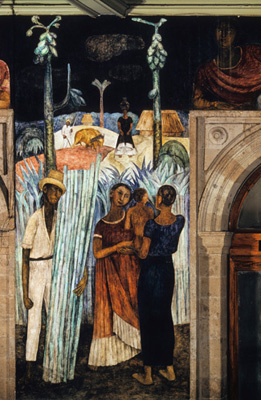
                            <div class="img"><img src="images/hs_Source-panel-from-Cuernavaca.jpg" alt="Sugar Plantation"></div>
								<div style="font-size: 13px; color: #8d8c8c; line-height: 16px; padding:15px 0;">Diego Rivera. <em>Sugar Plantation</em>. 1930. Fresco, approx. 14' 3 1/4" x 111" (4.35 x 2.82 m). Palacio de Cortés, Museo Regional Cuauhnáhuac, Instituto Nacional de Antropología e Historia, Cuernavaca, Mexico. © 2011 Banco de México Diego Rivera & Frida Kahlo Museums Trust, México, D.F./Artists Rights Society (ARS), New York. Photograph © 2011 Eumelia Hernández, Ricardo Alvarado; Instituto Nacional de Bellas Artes</div>
                                <p><em>Sugar Cane</em> is based loosely on a panel from Rivera’s mural cycle at the Palacio de Cortés in Cuernavaca, Mexico. The most noticeable change made to this source image is the family group added to the foreground of the portable mural. This detail offers a foil to the harsh scene of exploitation that unfolds in the middle and background of the work. Nonetheless, commentators in the U.S. press immediately recognized the panel’s political message, highlighting the “unremitting toil” depicted.</p></div>
                                
							<div class="hotspot-info position1">
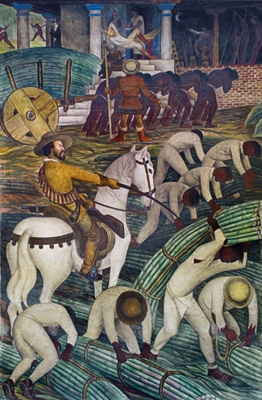
                            <div class="img"><img src="images/hs_Cane-Harvester.jpg" alt="Cane Harvest"></div>
								<div style="font-size: 13px; color: #8d8c8c; line-height: 16px; padding:15px 0;">Diego Rivera. <em>Cane Harvest</em>. 1923. Fresco, approx. 13' 11 1/4" x 83 7/8" (4.25 x 2.13 m). North wall of the Patio del Trabajo (Courtyard of Labor), first floor, Secretaría de Educación Pública, Mexico City. © 2011 Banco de México Diego Rivera & Frida Kahlo Museums Trust, México, D.F./Artists Rights Society (ARS), New York. Photograph by Schalkwijk/Art Resource, New York</div>
                                <p>Precedents for <i>Sugar Cane</i>’s focus on Indian peasants and workers are found in Rivera’s early mural panels at the Secretaría de Educación Pública, begun in 1923. At that time, viewers were unaccustomed to seeing Mexico’s native people as a worthy subject of high art, and many objected loudly to Rivera’s large-scale depictions of indigenous figures. </p></div>
                             
							<div class="hotspot-info position2">
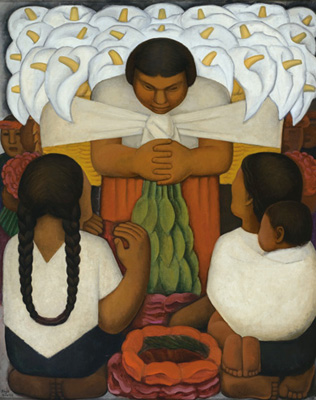
                            <div class="img"><img src="images/hs_Flower-Day.jpg" alt="Flower Day"></div>
								<div style="font-size: 13px; color: #8d8c8c; line-height: 16px; padding:15px 0;">Diego Rivera. <em>Flower Day</em>. 1925. Oil on canvas, 58 x 47 1/2" (147.32 x 120.65 cm). Los Angeles County Museum of Art, Los Angeles. The Los Angeles County Fund (25.7.1). © 2011 Banco de México Diego Rivera & Frida Kahlo Museums Trust, México, D.F./Artists Rights Society (ARS), New York. Digital image © 2011 Museum Associates/LACMA/Art Resource, New York</div>
                                <p>Considered separately from the rest of the panel, the woman and children in <em>Sugar Cane</em> might seem to invoke a picturesque vision of rural life. They recall other works by Rivera that promote a benign, folksy image of Mexico. Oil-on-canvas paintings like <em>Flower Day,</em> which won the purchase prize at the <em>First Pan-American Exhibition of Oil Paintings</em> at the Los Angeles Museum of History, Science, and Art (now known as the Los Angeles County Museum of Art), appealed to U.S. collectors but irked critics on the left who questioned Rivera’s political commitment. In <em>Sugar Cane,</em> the indigenous family, paired with a stark portrayal of unjust labor practices, illustrates that Mexico’s agrarian system exploited not only Indian men but also women and children.</p></div>
                            
							<div class="hotspot-info position3">
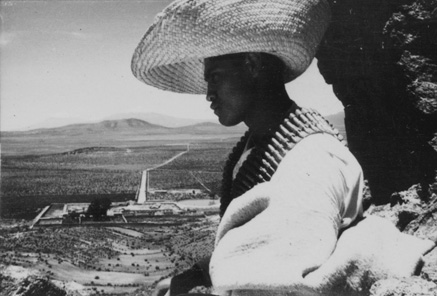
                            <div class="img"><img src="images/hs_Film-still.jpg" alt="іQue viva México!"></div>
								<div style="font-size: 13px; color: #8d8c8c; line-height: 16px; padding:15px 0;">Sergei Eisenstein (Russian, 1898–1948). Film still from <em>&iexcl;Que viva México!</em> 1931. 35mm print from unedited film footage. The Museum of Modern Art, New York. Photograph by The Museum of Modern Art, Department of Imaging Services (Robert Kastler)</div>
                                <p>In <em>Sugar Cane,</em> Rivera frames his composition as though he is looking through the viewfinder of a camera. The bodies of the female laborers at the lower edge of the work, for instance, are cut off at the waist, giving the impression that this panel presents only a fragment of a larger composition. Rivera’s practice of “cropping” his images may stem from his contact with photographers and filmmakers. He was a longtime friend of Tina Modotti, and he worked with the Soviet filmmaker Sergei Eisenstein on his unfinished masterwork <em>&iexcl;Que viva México!</em></p></div>
						</div>
						<div id="hotspots-nav">
							<a class="prev" href="#">prev</a>
							<div class="pages"></div>
							<a class="next" href="#">next</a>
						</div>
					</div>
					<?php include('../../../templates/murals-menu.tpl.php'); ?>
					<ul class="menu main-menu">
						<li class="home"><a href="<?php print $base_url; ?>">Home</a></li>
						<li class="menu"><a href="#">Menu</a></li>
						<li class="murals"><a href="#">Murals</a></li>
						<li class="sugar-cane active"><a href="#">Sugar Cane</a></li>
						<li class="zoom in"><a href="#" id="plus">Zoom In</a></li>
						<li class="zoom out"><a href="#" id="minus">Zoom Out</a></li>
						<li class="annotations">
							<a href="#">Annotations</a>
							<span>turn annotations off</span>
						</li>
						<li class="info">
							<a href="<?php print $base_path; ?>content/mural/<?php echo $mural; ?>/detail.php">Info</a>
							<span>return to mural Introduction</span>
						</li>
						<?php $audio = "media/audio.mp3"; ?>
						<?php if (file_exists($audio)) : ?>
							<?php include('../../../templates/audio-hotspots.tpl.php'); ?>
						<?php endif; ?>
					</ul>
				</div>
			</div>
		</div>
	</body>
</html>