<?php include('../../../inc/bootstrap.php'); ?>
<?php $mural = getMuralFolder(); ?>
<!DOCTYPE HTML PUBLIC "-//W3C//DTD XHTML 1.0 Strict//EN" "http://www.w3.org/TR/xhtml1/DTD/xhtml1-strict.dtd">
<html xmlns="http://www.w3.org/1999/xhtml">
	<?php $title = 'Agrarian Leader Zapata in Hotspots'; ?>
	<?php include('../../../templates/head.tpl.php'); ?>
	<body class="murals detail-hotspots">
		<div id="page">
			<div id="main">
				<div id="container">
					<div class="holder">
						<div class="hotspots">
							<a href="#" style="left:1%;top:1%;" class="level">hotspot</a>
							<a href="#" style="left:32%;top:42%;">hotspot</a>
							<a href="#" style="left:68%;top:36%;">hotspot</a>
							<a href="#" style="left:24%;top:27.5%;" class="deeper">hotspot</a>
						</div>
					</div>
				</div>
				<style type="text/css">
					#container {
						width: 594px;
						height: 750px;
					}
				</style>
				<script type="text/javascript">
					$(document).ready(function(){					
						$('#container').width($('#main').width());
						$('#container').height($('#main').height());
						$('#container').tilezoom({
							tile_size: 254,
							width: 2376,
							height: 3000,
							level: 10,
							smooth: 30,
							hotspotLevel: 11,
							minzoom: 10
						});
					});
				</script>
			</div>
			<div id="sidebar">
				<div id="menu">
					<?php include('../../../templates/menu.tpl.php'); ?>
					<div class="bar-content hotspots-page">
						<a id="bar-content-close" href="#">Close</a>
						<div class="content">
							<div class="hotspot-info position0 active">
								<div class="img"><img src="images/hs_Wall-of-palacio-de-Cortes-Cuernavada.jpg" alt="Full panel in Cuernavaca"></div>
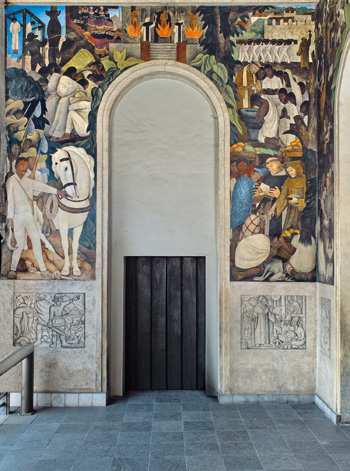
								<div style="font-size: 13px; color: #8d8c8c; line-height: 16px; padding:15px 0;">Diego Rivera.  South wall of the mural cycle <i>History of the State of Morelos: Conquest and Revolution</i>, with image of Emiliano Zapata. 1930. Fresco, approx. 19' 10 3/16" x 15' 9 3/4" (6.05 x 4.82 m). Palacio de Cortés, Museo Regional Cuauhnáhuac, Instituto Nacional de Antropología e Historia, Cuernavaca, Mexico. © 2011 Banco de México Diego Rivera & Frida Kahlo Museums Trust, México, D.F./Artists Rights Society (ARS), New York. Photograph © 2011 Eumelia Hernández, Ricardo Alvarado; Instituto Nacional de Bellas Artes</div>
								<p><em>Agrarian Leader Zapata</em> is based on a panel from Rivera’s mural cycle at the Palacio de Cortés in Cuernavaca, the capital of the Mexican state of Morelos. A native of that same state, Zapata led campaigns for land reform, including an effort to reorganize the area’s sugar industry into a system of cooperatives. In Rivera’s image, the rebel wields the type of machete used to harvest sugar cane, a clear reference to Zapata’s revolutionary agenda and Morelos’s most important agricultural product.</p>
							</div>
							<div class="hotspot-info position1">
								<div class="img"><img src="images/hs_Brehme-portrait-of-Zapata.jpg" alt="Brehme photo"></div>
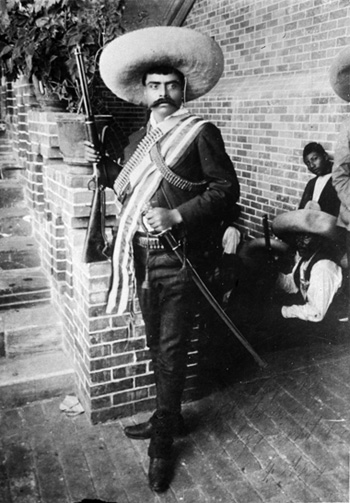
								<div style="font-size: 13px; color: #8d8c8c; line-height: 16px; padding:15px 0;">Emiliano Zapata at his headquarters in Cuernavaca. c. 1913. Photograph by Hugo Brehme. Casasola Archive, Fototeca Nacional del Instituto Nacional de Antropología e Historia, Pachuca, Mexico. © (186458) CONACULTA. INAH-SINAFO-FN-Mexico</div>
								<p>Dressed as a humble peasant in <em>huaraches</em> and a white cotton shirt and trousers, Rivera’s portrait of Zapata departs from portrayals propagated by popular press images and by the rebel himself. An expert horseman, Zapata consistently presented himself as a <em>charro</em>, a cowboy whose flamboyant dress—tight pants and a vest with silver ornamentation—signaled an elevated class status in Mexico. Rivera’s vision of Zapata as a humble peasant offers a sympathetic portrait of a folk hero tirelessly devoted to Mexico’s disenfranchised agrarian workers.</p>
							</div>
							<div class="hotspot-info position2">
                            
                            
                                <div class="img"><img src="images/hs_Detail-from-Battle-of-San-Romano-ART62732_R1.jpg" alt="Detail from Battle of San Romano"></div>
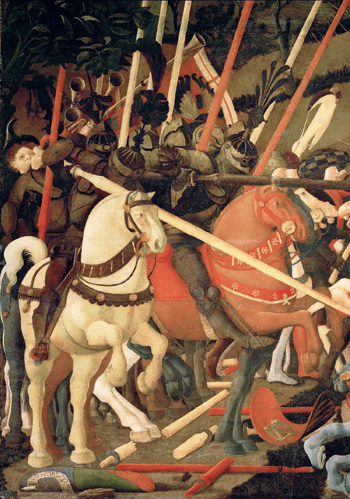
								<div style="font-size: 13px; color: #8d8c8c; line-height: 16px; padding:15px 0;">Paolo Uccello (Italian, c. 1397–1475). <i>The Battle of San Romano</i> (detail). c. 1438. Tempera on wood. Full panel: 71 3/4" x 10' 5 1/2" (1.82 x 3.22 m). Galleria degli Uffizi, Florence, Italy. Photograph by Erich Lessing/Art Resource, New York</div>
								
								<div class="img"><img src="images/hs_Zapata-on-horseback.jpg" alt="Zapata on a black horse"></div>
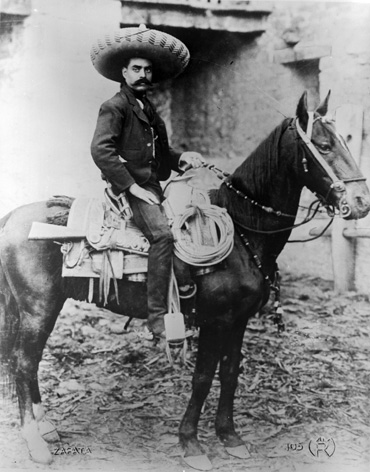
								<div style="font-size: 13px; color: #8d8c8c; line-height: 16px; padding:15px 0;">Emiliano Zapata on horseback. c. 1915. Photographer unknown. Casasola Archive, Fototeca Nacional del Instituto Nacional de Antropología e Historia, Pachuca, Mexico. © (186444) CONACULTA. INAH-SINAFO-FN-Mexico</div>
								<p>Rivera ennobles Mexican history—and Zapata—in this work by linking them to the grandeur of European artistic tradition. The steed, whose owner Zapata has just dragged from his saddle, shares the color and imposing presence of horses in Paolo Uccello’s early 15th-century painting <em>The Battle of San Romano,</em> which Rivera studied on a 1920–21 trip to Italy. Visual parities between Zapata and the horse in terms of scale and color have led commentators to assume the animal belongs to the revolutionary, whose actual horse was black.</p>
							</div>
							<div class="hotspot-info position3">
								<div class="img"><img src="images/hs_Book-illustration.jpg" alt="Book illustration"></div>
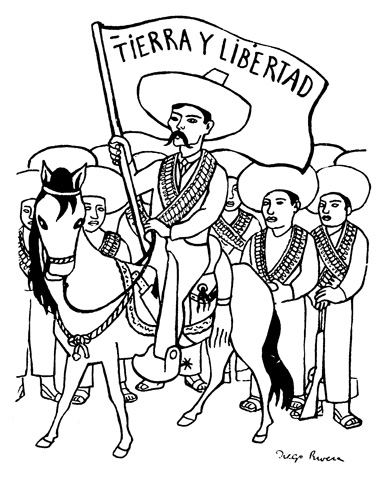
								<div style="font-size: 13px; color: #8d8c8c; line-height: 16px; padding:15px 0;">Diego Rivera. Illustration of Emiliano Zapata on horseback, as reproduced in Manuel Velázquez Andrade, <i>Fermín. Libro mexicano de lectura para primer año</i> (Mexico City: Secretaría de Educación Pública, 1927). © 2011 Banco de México Diego Rivera & Frida Kahlo Museums Trust, México, D.F./Artists Rights Society (ARS), New York. Photograph courtesy Editorial RM</div>
								<p>Rivera continually reinvented the image of Zapata for didactic purposes. He often drew upon photographs and images of the revolutionary that were distributed widely by press outlets, modernizing his mural practice by integrating these new media forms. Aimed at a broad audience of diverse ages, social and economic classes, and nationalities, Rivera’s portraits of the revolutionary leader appeared in a variety of media, ranging from his monumental mural cycles to prints and book illustrations. </p></div>
						</div>
						<div id="hotspots-nav">
							<a class="prev" href="#">prev</a>
							<div class="pages"></div>
							<a class="next" href="#">next</a>
						</div>
					</div>
					<?php include('../../../templates/murals-menu.tpl.php'); ?>
					<ul class="menu main-menu">
						<li class="home"><a href="<?php print $base_url; ?>">Home</a></li>
						<li class="menu"><a href="#">Menu</a></li>
						<li class="murals"><a href="#">Murals</a></li>
						<li class="agrarian active"><a href="#">Agrarian Leader Zapata</a></li>
						<li class="zoom in"><a href="#" id="plus">Zoom In</a></li>
						<li class="zoom out"><a href="#" id="minus">Zoom Out</a></li>
						<li class="annotations">
							<a href="#">Annotations</a>
							<span>turn annotations off</span>
						</li>
						<li class="info">
							<a href="<?php print $base_path; ?>content/mural/<?php echo $mural; ?>/detail.php">Info</a>
							<span>return to mural Introduction</span>
						</li>
						<?php $audio = "media/audio.mp3"; ?>
						<?php if (file_exists($audio)) : ?>
							<?php include('../../../templates/audio-hotspots.tpl.php'); ?>
						<?php endif; ?>
					</ul>
				</div>
			</div>
		</div>
	</body>
</html>