- Housing for the Fishermen of Tyre
- 1998–2008
- Tyre, Lebanon
- Hashim Sarkis A.L.U.D.
- OverviewClose
Tyre, an ancient coastal city south of Beirut, has long struggled to maintain a viable infrastructure amid seemingly constant chaos and combat. The area’s fishermen—many of whom earn as little as fifteen dollars a day—have been particularly hard hit, as longstanding conflict with Israel has prevented them from deep-sea fishing. In 1984, during the Lebanese Civil War, the ancient city was added to the UNESCO World Heritage List. The designation brought with it strict regulations on new building along the coast, where the fishermen have traditionally lived, perpetuating overcrowded and unsanitary conditions. In response, the fishermen formed the Al Baqaa Housing Cooperative, convinced the Greek Orthodox Church to donate a parcel of land outside the historic city center, and partnered with architect Hashim Sarkis (with the help of the Association for Development of Rural Areas in South Lebanon), whose practice and teaching have long been focused on the Islamic world.
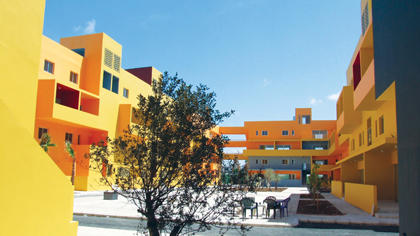
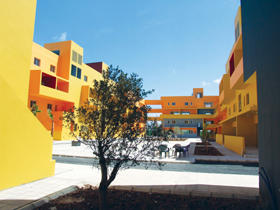
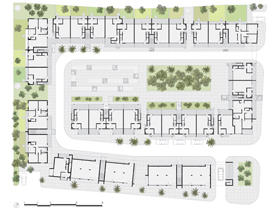
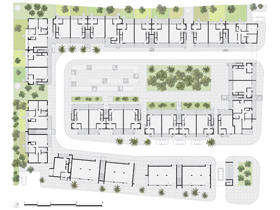
In a decade-long collaboration with the cooperative, Sarkis developed a vibrant, modern housing system that not only accommodates the fishermen’s ambitious program and small budget but fosters a rich sense of community with a balance between private and public space, in keeping with the fishermen’s traditional lifestyle. The building, a composite of nine residential blocks, turns inward on itself like a rectilinear nautilus, creating a protected interior courtyard. Fusing architecture, landscape design, and urban planning, Sarkis’s collaborative approach to design has resulted in a residential complex that exemplifies the power of architecture to offset chaotic conditions while respecting the specific social and cultural conditions of the community.
-
Architect
Close
Hashim Sarkis received his Bachelors Degree in Architecture at the Rhode Island School of Design (1987) and his Masters in Architecture (1989) and PhD in architecture (1995) from Harvard University. After working for Rafael Moneo, in 1998 he founded Hashim Sarkis Studios in Cambridge, Massachusetts, and Beirut, Lebanon. The practice works on a broad range of projects, from urban master planning and landscape design to institutional and residential building. A special focus of its research and practical work is to improve the built environment and social conditions in Lebanon and the Middle East. In 2002 Sarkis was appointed Aga Khan Professor of Landscape Architecture and Urbanism in Muslim Societies at Harvard's Graduate School of Design.
-
Audio
Close
- CreditsClose
- Design Team: Hashim Sarkis (architect); Ezra Block, Ryan Bollom, Cynthia Gunadi, Scott Hagen, David Hill, Ziad Jamaleddine, Paul Kaloustian, Brian Mulder, Cheyne Owens, Erkin Ozay, Anuraj Shah, Mete Sonmez (collaborators)
- Landscape design: Hashim Sarkis Architecture Landscape Urban Design
- Engineers: Mohamed Chahine and Mounir Mabsout (structural engineers)
- Construction: EBCO-BITAR
- Client: Al Baqaa Housing Cooperative; Association for Development of Rural Areas in South Lebanon (ADR)
-

- Color study Image credit: Hashim Sarkis A.L.U.D. Close
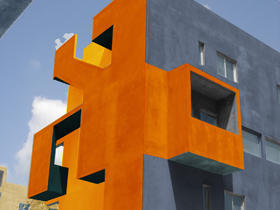
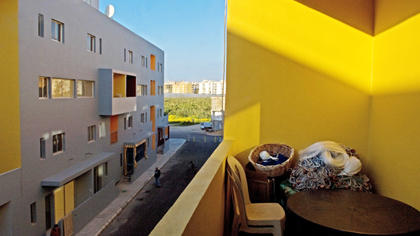
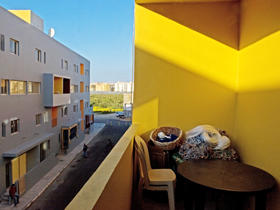
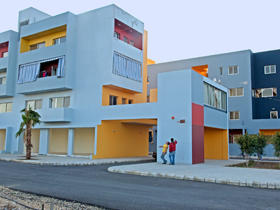
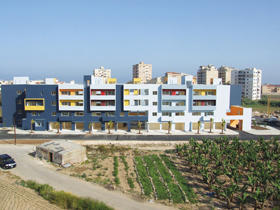
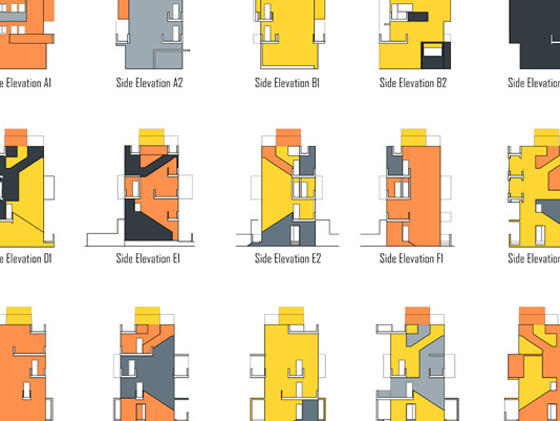
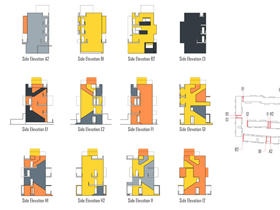
Sarkis planned to add geometric stenciling to the building’s stucco exterior, but because of budget limitations he chose to paint the complex instead. First Sarkis produced a series of digital color studies, three of which are on display here. He assigned cooler colors (blues and grays) to the exterior, warmer ones (yellows and oranges) to the courtyard areas, and a combination of the two at each intersecting elevation. The brightest colors were assigned to the darkest areas—the balconies and stair halls—in a playful experiment with light and shadow.
- 1 of 3
-

- Color study Image credit: Hashim Sarkis A.L.U.D. Close
- 2 of 3
-

- Color study Image credit: Hashim Sarkis A.L.U.D. Close
- 3 of 3
-

- Excerpt of “Tyre 1, 2, 3, 4, 5: Portrait of a Housing Cooperative” Video credit: Lamia Joreige Close
This video installation features five different views of the housing complex. It is presented in the exhibition on four monitors. The screens can only accommodate four images at a time, so at least one sequence is always missing, underscoring the filmmaker’s opinion that the project is too complex to be taken in at once. The unedited footage captures daily life as it unfolds within and around the complex.
- 1 of 1
-

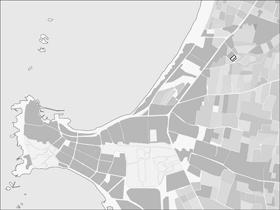
- Map of Tyre with housing complex at upper right Image credit: Hashim Sarkis A.L.U.D. Close
- 1 of 1
-

- View of courtyard Image credit: Bilal Ashmar Close
- 1 of 1
-

- View of exterior Image credit: Joumana Jamhouri Close
- 1 of 2
-

- View of exterior Image credit: Joumana Jamhouri Close
- 2 of 2
-

- View of exterior Image credit: Joumana Jamhouri Close
Narrow pedestrian passageways and two main vehicular access points are incised into the mass of the complex, creating arteries for circulation. The project provides a balance of public and private areas, including four storefront units.
- 1 of 2
-

- View of exterior Image credit: Joumana Jamhouri Close
- 2 of 2
-

- Unit distribution diagram Image credit: Hashim Sarkis A.L.U.D. Close
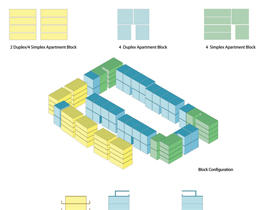
Early in the development and planning stages of this project, Sarkis proposed that the complex comprise three different apartment types. The fishermen were initially skeptical of the idea, but using models, drawings, and other pedagogical tools Sarkis persuaded them that differing configurations would compensate for inevitable discrepancies in location and view. Every apartment includes outdoor space: lower duplexes, on the ground and first floors of the building, have private gardens; one-story flats that face the interior road have a minimum of two balconies; and upper duplexes have roof access. Each apartment is roughly 925 square feet with about half as much again in additional outside space.
- 1 of 1
-

- Ground floor Image credit: Hashim Sarkis A.L.U.D. Close
- 1 of 6
-

- Floor 2 Image credit: Hashim Sarkis A.L.U.D. Close
- 2 of 6
-

- Floor 3 Image credit: Hashim Sarkis A.L.U.D. Close
- 3 of 6
-

- Floor 4 Image credit: Hashim Sarkis A.L.U.D. Close
- 4 of 6
-

- Floor 5 Image credit: Hashim Sarkis A.L.U.D. Close
- 5 of 6
-

- Roof Image credit: Hashim Sarkis A.L.U.D. Close
- 6 of 6
-

- Diagram of site development Image credit: Hashim Sarkis A.L.U.D. Close
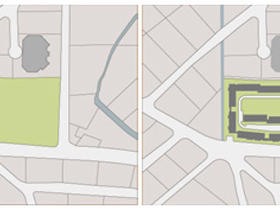
The fishermen’s housing is located on a 1.75-acre parcel of land in Abbassiyeh, a formerly agricultural area outside Tyre peppered with ad hoc structures developed after the Lebanese Civil War (1975–90). This diagram shows the gradual subdivision and fragmentation of the area over time. Sarkis felt it was essential to develop a housing complex that would mitigate the fishermen’s feeling of dislocation from their coastal community, further complicated by the chaos of surrounding speculative development. To achieve this he integrated a central courtyard into the design, creating sightlines between apartments to foster a sense of community and maintain social connections.
- 1 of 1
-

- View of complex Image credit: Joumana Jamhouri Close
- 1 of 1
-
- Interior elevations Image credit: Hashim Sarkis A.L.U.D. Close
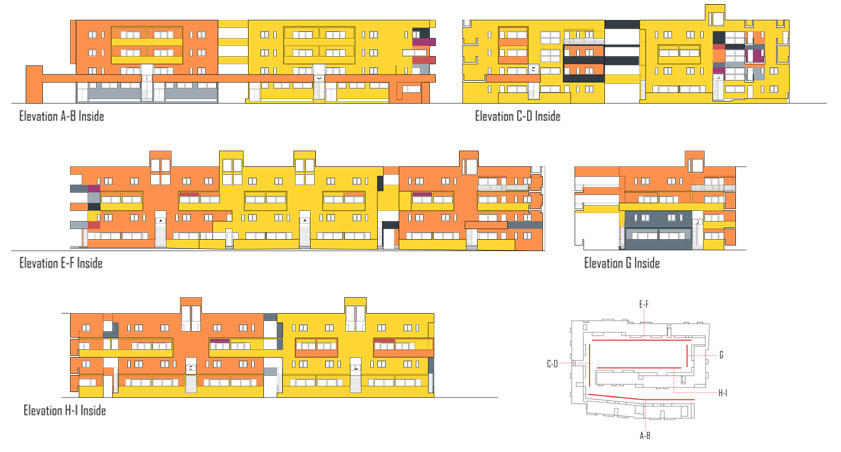
Balconies, stairways, patios, and entryways protrude from the building, casting cool shadows, while other areas of the facades recede. This differentiation lends the complex the visual diversity of a city streetscape.
- 1 of 3
-

- Exterior elevations Image credit: Hashim Sarkis A.L.U.D. Close
- 2 of 3
-

- Side elevations Image credit: Hashim Sarkis A.L.U.D. Close
- 3 of 3