-
1961
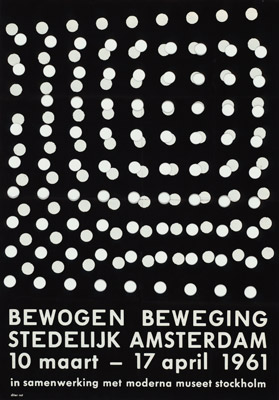
Poster for BEWOGEN BEWEGING. 1961
Design: Dieter Roth (Swiss, born Germany. 1930–1998)
Screenprint, 39 3/8 x 27 9/16" (100 x 70 cm)
The Museum of Modern Art, New York. Gift of the Stedelijk Museum, Amsterdam, 1961The Stedelijk Museum, Amsterdam's modern art museum, presents Bewogen Beweging (Moved movement), an exhibition of kinetic art that introduces work by an emerging generation of artists including Daniel Spoerri, Jean Tinguely, Robert Müller, Jesús Rafael Soto, and Roth. Roth designs the exhibition poster—a large black sheet screenprinted with white dots and punched with holes—meant to be hung on top of existing street posters.
-
1962
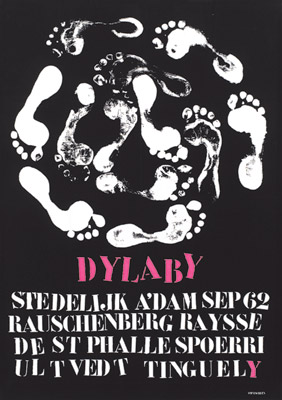
Poster for DYLABY. 1962
Design: Design: Piet van der Have (Dutch, born 1930)
Martial Raysse (French, born 1936)Screenprint, 39 3/8 x 27 9/16" (100 x 70 cm)
The Gielijn Escher Poster Collection, AmsterdamDylaby: dynamisch labyrint, at the Stedelijk Museum, features a "dynamic labyrinth" composed of a succession of environments, each aiming to generate public interaction. Niki de Saint Phalle, for instance, designs "shooting galleries," in which visitors shoot at bags full of paint that hang above white sculptures suggesting phantasmagorical animals, dinosaur skeletons, and plaster heads, and Jean Tinguely fills the final gallery with colored balloons blown about by fans.
-
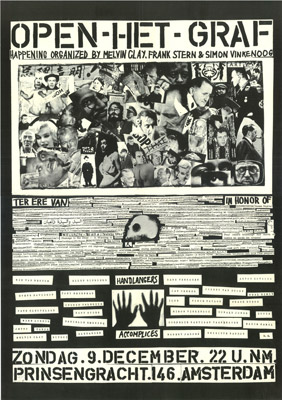
Poster for OPEN THE GRAVE. 1962
Photolithograph, 22 5/8 x 15 15/16" (57.5 x 40.5 cm)
Harry Ruhé/Galerie A, AmsterdamOn December 9 Open-Het-Graf (Open the grave)— probably the first Happening presented as such in the Netherlands—is set up in a local artist's studio. Organized by New York Living Theater actor Mel Clay, film producer Frank Stern, and writer Simon Vinkenoog, the event features artists performing actions in an environment filled with streamers, paintings, photographs, rotting meat, and cow intestines.
-
1963
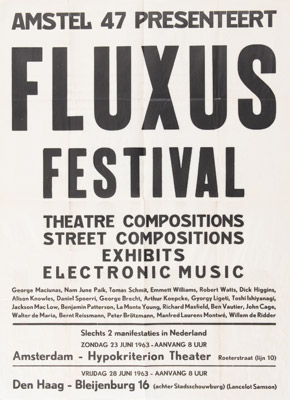
Poster for FLUXUS FESTIVAL. 1963
Design: Willem de Ridder (Dutch, born 1939)
Letterpress, 33 7/16 x 24 5/16" (85 x 61.7 cm)
The Museum of Modern Art, New York. The Gilbert and Lila Silverman Fluxus Collection Gift, 2008On June 23 a festival dedicated to Fluxus—an international movement in the 1960s and 1970s that brought together artists working with music, poetry, theater, film, and the visual arts—is organized by de Ridder in collaboration with Fluxus founder George Maciunas. Presented at the Hypokriterion Theater, it features "theater compositions, street compositions, exhibits, and electronic music." De Ridder becomes the Fluxus Northern European representative, organizing numerous events in subsequent years.
-
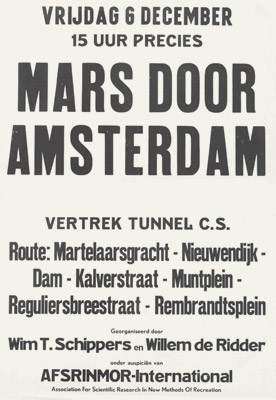
Poster for MARCH THROUGH AMSTERDAM. 1963
Design: Willem de Ridder (Dutch, born 1939)
Letterpress, in two parts, overall 43 5/16 x 31 5/8" (110 x 80.4 cm)
The Museum of Modern Art, New York. The Gilbert and Lila Silverman Fluxus Collection Gift, 2008Artists Wim T. Schippers and de Ridder, under the auspices of AFSRINMOR (Association for Scientific Research in New Methods of Recreation)—a group the two created with Stanley Brouwn to encourage new forms of perception—organize Mars door Amsterdam (March through Amsterdam). On December 6 for seventeen minutes, six men march inconspicuously along a specified route from Amsterdam's main train station to Rembrandtsplein, a central square.
-
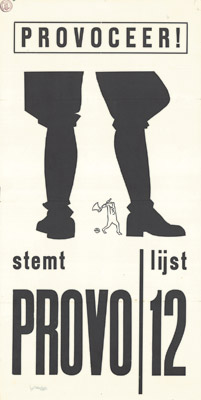
1966
Election poster (PROVOKE! VOTE PROVO). 1966
Design: Willem
Photolithograph, 19 11/16 x 9 15/16" (50 x 25.2 cm)
Collection, International Institute of Social History, AmsterdamAmong the many Dutch protest groups that arise as part of the youth activist movement, Provo, founded in 1965, is one of the largest and most notorious. Its members stage Happenings throughout Amsterdam to gain publicity for their anti-authoritarian causes. A campaign for recognition in the local government earns Provo representation on the city council in 1966.
-
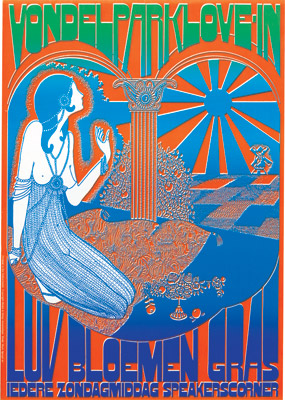
1968
Poster for VONDELPARK LOVE-IN. 1968
Design: Willem de Ridder (Dutch, born 1939)
Screenprint, 24 3/8 x 17 1/4" (61.9 x 43.8 cm)
Collection, International Institute of Social History, AmsterdamVondelpark, the largest public park in Amsterdam, becomes a central gathering place for the city's counterculture during the "flower power" era. This street poster presents a distinctively Dutch rendering of psychedelia, incorporating a windmill and a patchwork pattern of flower fields.
-
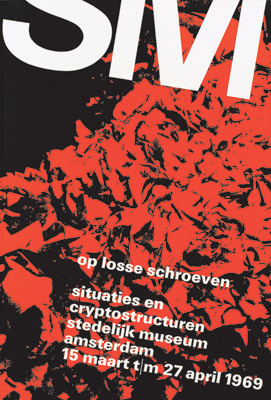
1969
Poster for VONDELPARK LOVE-IN. 1969
Design: Wim Crouwel/Total Design (Dutch, born 1928)
Photolithograph, 37 13/16 x 25" (96 x 63.5 cm)
The Gielijn Escher Poster Collection, AmsterdamThe Stedelijk Museum presents Op Losse Schroeven: situaties en cryptostructuren (Square Pegs in Round Holes: Situations and Cryptostructures), an exhibition bringing together a range of artistic practices that emerged after the first wave of Minimalism and Pop art in the early 1960s. Described variously as Conceptual art, Post-Minimal art, Arte Povera, earthworks, and Process art, the works in this show share an affinity for process over product, favoring materials and ideas over composition and execution.
-
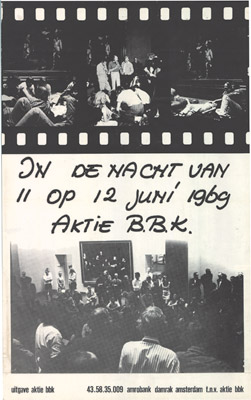
Poster for B.B.K. event at Rijksmuseum. 1969
Design: Beroepsvereniging van Beeldende Kunstenaars (The Netherlands, established 1967)
Screenprint, 36 3/4 x 22 3/4" (93.3 x 57.8 cm)
Collection, International Institute of Social History, AmsterdamOn June 11 artists from the Belangengroep Beeldende Kunstenaars (B.B.K.), a professional union advocating for artists' rights and government support of the arts, occupy the room at the Rijksmuseum housing Rembrandt's The Company of Frans Banning Cocq and Willem van Ruytenburch (The Night Watch), calling for a greater role for artists in determining Dutch cultural policy.
-
1971
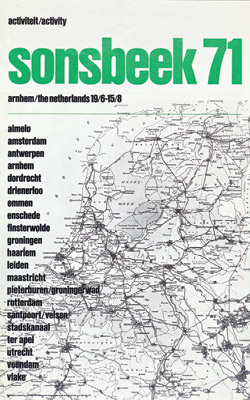
Poster for SONSBEEK 71. 1971
Design: Wim Crouwel/Total Design (Dutch, born 1928)
Photolithograph, 33 1/6 x 20 11/16" (84 x 52.5 cm)
Netherlands Institute for Art History, RKD, The HagueThe international sculpture exhibition Sonsbeek, historically limited to Sonsbeek Park in Arnhem, extends its presence throughout the Netherlands. Sonsbeek 71—Sonsbeek buiten de perken (Sonsbeek Beyond the Pale) features site-specific projects in Dutch towns and rural areas, publications, and audiovisual works, all of which challenge traditional notions of sculpture. The exhibition includes a number of artists presented here in In & Out of Amsterdam: Bas Jan Ader, Stanley Brouwn, Hanne Darboven, Jan Dibbets, Ger van Elk, Sol LeWitt, and Lawrence Weiner.