
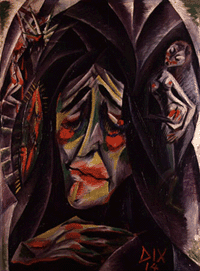

At the start of the twentieth century in Germany, Expressionism paralleled the development of Fauvism in France. Influenced by Matisse, Fauvism pushed the boundaries of representational art to the limit with saturated color, sharply contrasting tonalities, bold drawing, loose contours, generalized forms, and an overall vibrancy. It excited the senses and stirred the emotions. Expressionism hit its climax before the outbreak of the World War I, and by the war's end, its energies as a movement had been spent.
Neue Sachlichkeit, or New Objectivity--a postwar German sensibility that preferred unblinking description of hard facts-had a similar relationship to the preceding Expressionism as Neoclassicism did to Cubism. The example of former vanguardists in France returning to traditional formats and techniques played a crucial part in steering modern German art in a more formally conservative direction after 1918.
Although some critics have linked the Neue Sachlichkeit with the German reactionary tendency that led to fascism, it was, for the most part, intrinsically incompatible with Nazi doctrine. Rather than being stalking horses for authoritarian art, Neue Sachlichkeit artists were at their best unrivaled chroniclers of Germany's tragedy, with all its terrible contradictions.
 |
 |