
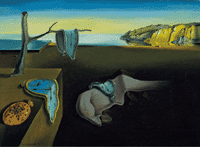

To varying extents, virtually all the Surrealists toyed with disorienting anachronisms, but none played the game longer or more extravagantly than Salvador Dali. The Persistence of Memory, an unforgettable and profoundly subversive image, turns time, in the form of molten watches, into the last reliable measure of reality.
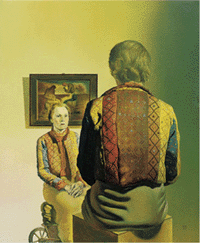
His Portrait of Gala (L'Angelus de Gala) is a modern reprise of the Spanish baroque. The unexplained doubling of the sitter, who was his wife, references the reflection in the mirror in Diego Velázquez's 1656 Las Meninas (The Maids of Honor). Along with the sharp sculptural lighting of the figure and the deft brushwork, his rendition of Jean François Millet's painting The Angelus (1857-59) footnotes the picture with his tongue-in-cheek admiration for that saccharine icon.
A retrograde painter of a high order, Dali took Surrealism's antimodernist implications to the furthest extremes. In 1948, he prefaced his book 50 Secrets of Magic Craftsmanship with this credo:
"At the age of six I wanted to be Napoleon--and I wasn't. At the age of fifteen I wanted to be Dali and I have been. At age twenty-five I wanted to become the most sensational painter in the world and I achieved it... Now at forty-five I want to paint a masterpiece and to save Modern Art from chaos and laziness."[6]
Having been expelled by the Surrealists early on for his grandstanding, Dali mounted a one-man campaign for a modern art based on a systematic perversion of old-master technique, which, rather than destroying tradition, would save it by making it glamorous and competitive with the novelties of the avant-garde. The impact of Dali's gesture proved that Surrealism was not forward-looking in any aesthetically reliable way.
 |
 |