

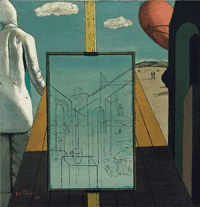
Former followers of Futurism looked to another great visionary of the period, Giorgio de Chirico, praised by André Breton, the French poet and theoretician, who said, "I believe that a true modern mythology is in the making. It lies with Giorgio de Chirico to give an imperishable shape to its memory." [4] Despite Breton's attempts to draft him into the movement, de Chirico's pictorial poetry had nothing dogmatically psychoanalytic or revolutionary about it. Nonetheless, De Chirico anticipated the rhetoric of Surrealism in its visionary emphasis. "What I hear is worth nothing to me," he wrote in 1914, "there is only what my eyes see when they are open, and more often when they are closed."[5]
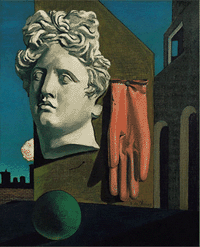
His 1914 "The Song of Love" is a strange, premodern collage in a painterly form, in which a Roman head of Apollo is affixed to a wall, beside a rubber glove. Setting his scenes in Renaissance piazzas reminiscent of his native Ferrara, de Chirico ornamented those squares with draped goddesses who mingle with geometrized mannequins and men in swallowtail coats.
De Chirico's impact on the art of the 1920s and 1930s is owed to the brittle, twilight universe he invented and to the spell he cast over minds still absorbing the shock of World War I. He strived to flee backward in time by resuscitating archaic styles, depicting lost worlds, and evoking primordial states of mind. His escalating momentum of modernity is an ironic and abrupt turnaround from the futurist's call to destroy the imprint of the past in order to speed up progress.
 |
 |