
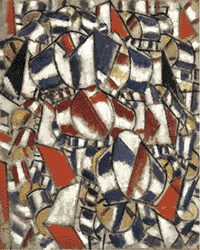

Prior to military service, Fernand Léger had nearly reached complete abstraction in his Contrast of Form paintings of 1913. Rather than losing his faith in modernity during the war that he fought in, he reconfirmed it and retooled his work to develop a schematic but robust naturalism. A man of the Left, he noted, "My new comrades were miners, labourers, artisans who worked in wood or metal...At the same time I was suddenly stunned by the sight of the open breech of a .75 cannon in full sunlight, confronted with the play of light on white metal. It needed nothing more than this for me to forget the abstract art of 1912-13."[3]
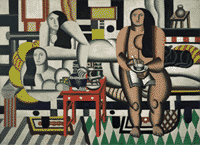
Rediscovering the reality implicit in geometry after an epiphany triggered by his fascination with the guns he saw in the trenches, Léger stuck to traditional Cubist formats--figure studies, interiors, still lifes, and landscapes--but injected them with a classical rigor. However, his neoclassicism, exhibiting little antiquity and a lot of industrial streamlining, departed from that of his confederates. As distinct from the languorous reclining nudes of Matisse or the Sabine women of Picasso, the bumpy odalisques in Léger's Three Women (Le Grand Déjeuner) resemble three Rubensian graces stylishly coiffed, poured into tubular body stockings, and posed in an Art Deco apartment.
Léger retreated from the frontier of pure, nonobjective art, adapting the conservative iconography and formats of his Neoclassicist contemporaries to his special needs. In so doing, he abdicated his place in the front ranks of the avant-garde, but he had not abandoned modernism, hoping to redirect its "destructive" methodologies toward the reconstruction of painting at the service of an egalitarian society. This postwar concern with rebuilding tilts decisively toward conservatism.
 |
 |