
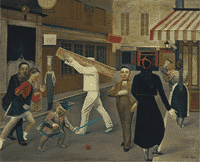

Balthus, or Count Balthasar Klossowski de Rola, as he has chosen to call himself, is one of the last surviving examples of the classic Baudelairean dandy, feigning indifference to the everyday world. His mature work is a sardonic amalgam of interwar artistic devices. It invokes tradition from every angle but is infused with studied perversity. Like many artists of the 1920s and 1930s, Balthus schooled himself in museums, where, during that period, post-World War I nationalistic pressures prompted a rewriting of the genealogies of French painting. Feeding off a convergence of conservatisms, Balthus was influenced by the eccentric, literary pictures of Henry Fuseli, the stiff genre paintings of Joseph Reinhardt, and eighteenth- and nineteenth-century children's illustrations and vernacular prints from France. The bad boy of academic art, Balthus synthesized old-master painting and period kitsch to produce pictures that were arch, satirical, and sometimes obscene.
Balthus's abrupt shifts in scale and his habit of attaching big heads to small bodies confound the basic rules of perspective and composition. In viewing The Street, one remains perpetually uncertain whether the indeterminately aged couple at the extreme left is engaged in a harmless game of tag or an amorous chase, whether he is molesting her and she is escaping, or she is teasing him and he is snatching at the bait.
 |
 |