
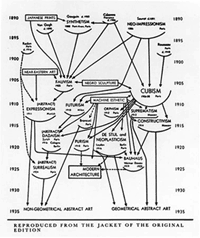

This is the chart that Alfred Barr, The Museum of Modern Art's founding director, created of the origins of modern abstraction. It was drawn for the catalogue of Barr's 1936 exhibition Cubism and Abstract Art. It is based on his torpedo drawing and traces abstraction from its headwaters in Japanese prints, Cézanne, and Neo-Impressionism down through African sculpture, Cubism, Futurism, Expressionism, Constructivism, and so on to broadly breaking waves of "geometrical" and "non-geometrical abstract art." While this encompasses many of the tendencies upon which the Museum concentrated in the first decade and a half of its existence, the chart's top-to-bottom breadth follows a zigzag artistic course that never funnels into a single channel or aesthetic.
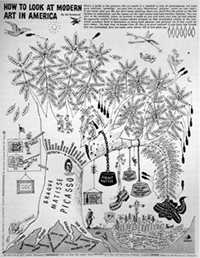
Modernism has been attacked from without by those who believed that avant-garde art has been a destructive social force and from within by vanguardists keen to checkmate the competition. Modernist art and its advocated have grown accustomed both to jeering antagonists and to subversive endgame moves. In the 1950s, Ad Reinhardt, the painter of numerous red, blue, white, and black monochromes was the self-proclaimed author of "the last paintings which anyone can make."[1] At the same time, he was also mercilessly caricaturing his Abstract Expressionist colleagues and just about every other artist and movement of the postwar era in numerous cartoon drawings such as "How to Look at Modern Art in America".
 |
 |