<?php require_once("../../include/header_p1.html");?>
<title>MoMA.org | Red Studio | Contests | Character Sketch Contest</title>
<?php require_once("../../include/header_p2.html");?>
<table width="100%"  border="0" cellspacing="0" cellpadding="0">
                    <tr>
                      <td><img src="../../images/interior/interior_topBar.gif" width="550" height="10"></td>
                    </tr>
                    <tr>
                      <td><table width="100%"  border="0" cellspacing="0" cellpadding="0">
                          <tr>
                            <td width="15" valign="top" bgcolor="#F3F3F3"><img src="../../images/interior/interior_top_left.gif" width="15" height="15"></td>
                            <td valign="top" background="../../images/interior/content_bk.gif"><p><img src="/interactives/redstudio/images/character_head.gif" width="520" height="21"></p>
                              <p align="center"  class="body"><a href="index.php">Contest Description</a> | <a href="character_winners.php">Winners</a> | <a href="character_hm.php">Honorable
                              Mention</a> | <a href="character_judges.php">Judges</a> | <a href="rules.php">Guidelines & Rules</a></p>
                              <p><img src="../../images/rule.gif" width="520" height="2"></p>
                              <p><a href="character_winners.php"><img src="/interactives/redstudio/images/character_head_october.gif" alt="Character Sketch Contest" width="520" height="222" border="0"></a></p>
                              <p><strong class="headline">Over the last one hundred
                                  years, animators have produced such memorable
                                  characters as Mickey Mouse, Betty Boop, Jack
                                  Skellington, Wallace and Gromit, Princess Mononoke,
                                  and a fish named Nemo. Now it's your turn. </strong></p>
                              <p class="body">Use a mouse, a pencil, a paintbrush&mdash;whatever
                                it takes to create and develop a character of
                                your own invention! Submissions must be accompanied
                                by a descriptive essay or story about your character.</p>
                              <p class="body">Each qualified winner will receive their choice
                                of either a <b>Mini DV Camcorder</b> (including
                                tripod, case, and accessory kit) or a gift certificate
                                for <b>art supplies</b> in the amount
                                of equal value to the camera.</p>
                              <table width="100%"  border="0" cellspacing="0" cellpadding="10">
                                <tr>
                                  <td><table width="100%"  border="0" cellpadding="10" cellspacing="0">
                                      <tr>
                                        <td class="border1ptRed"><div align="center" class="body"><strong class="headline_red"> The
                                              Character Sketch Contest is now
                                              closed.</strong><br />
                                                                              <strong>The
                                                                              deadline for submissions was
                                                                              June 30, 2006. <br />
              Winning entries will be posted in October.<br />
              For more information, please review the <a href="rules.php">Contest
              Guidelines &amp; Rules</a>. </strong></div></td>
                                      </tr>
                                  </table></td>
                                </tr>
                              </table>
                              <p align="left"><strong><img src="/interactives/redstudio/images/rule.gif" width="520" height="2"></strong></p>
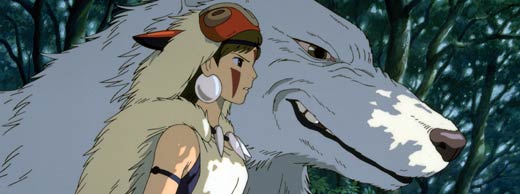
                              <p class="headline"><img src="/interactives/redstudio/images/Princess_Mononoke_1997_head.jpg" width="520" height="194"  alt="Princess Mononoke (Mononoke-hime).</em> 1997.
                                        Japan. Written and Directed by Hayao Miyazaki. &copy; Miramax Films. Miramax Films/Photofest></p>
                                    <p class="headline"></p>
                              <p class="headline">A Look at Some Memorable Characters
                                from the History of Animation</p>
                              <p class="body">What makes animation special? Why do we have
                                such dear attachments to favorite animated characters?
                                How have certain characters maintained their
                                appeal across generations? Let&rsquo;s take a
                                look at different characters throughout the history
                                of animation and see how the process of bringing
                                them to life has changed over the years.</p>
                              <p class="body"><strong><img src="/interactives/redstudio/images/Gertie_The_Dinosaur_1914.jpg" width="156" height="143" align="right">Gertie
                                  the Dinosaur</strong><br />
  Did you know that the first animated film began as a bet between two newspaper
  cartoonists? Winsor McCay was inspired to create <i>Gertie the Dinosaur</i> by
  studying the Apatosaurus at New York City&rsquo;s American Museum of Natural
  History. He and his assistant drew ten thousand sketches on rice paper, including
  backgrounds on every page. It premiered in 1914 in Chicago at a dinner party
  for McCay and his friends&mdash;which was the prize for winning the bet!</p>
                              <p class="body"><strong><img src="/interactives/redstudio/images/Disney_SteamboatWillie_2.jpg" width="185" height="133" align="left">Steamboat
                                  Willie<br />
                                </strong>Mickey Mouse has had many transformations
                                since he was conceived by Walt Disney and Ub
                                Iwerks. Disney and Iwerks were a dynamic team:
                                Disney developed story ideas and Iwerks sketched
                                out storyboards and designs, producing about
                                seven hundred drawings a day! <i>Steamboat Willie,</i> Mickey's
                                cartoon debut, was the first film in which picture
                                and sound were synchronized. Musician Wilfred
                                Jackson worked with Disney, who was the voice
                                of Mickey, and synchronized sound to animation
                                with a harmonica and a metronome. The music was
                                recorded after the animation had been filmed
                                to a predetermined tempo. The band played the
                                score while they watched the film, keeping tempo
                                with a visual cue that Iwerks had illustrated
                              on the film frames!</p>
                              <p class="body"><strong><img src="/interactives/redstudio/images/MF_Questel_Boop.jpg" width="230" height="257" align="right">Betty
                                  Boop<br />
                                </strong>Betty used to bark! Believe it or not,
                                when Betty Boop was first created in 1930, she
                                was a dog&mdash;a French poodle, to be exact.
                                Betty first appeared as the love interest of
                                fellow pooch Bimbo the Dog. In 1932 her creators,
                                two brothers named Dave and Max Fleischer, changed
                                her into the character we&rsquo;re familiar with
                                today. She was based on the singer Helen Kane,
                                and had the esteemed pleasure of introducing
                                viewers to another animated character: Popeye.
                                The handsome couple appeared together, dancing
                                the hula in the Fleischers&rsquo; 1933 Betty
                                Boop cartoon entitled <em>Popeye the Sailor</em>.
                                Even as animation&rsquo;s best dancer, Betty
                                couldn&rsquo;t be as successful as <em>Steamboat
                                Willie,</em> because the music-picture coordination
                                was not synchronized. Later, she ran into some
                                more trouble with the introduction of censorship.
                                In 1934 the Hays Production Code was approved
                                and Betty&rsquo;s &ldquo;boop-oop-a-doo&rdquo; persona
                                was deemed a little too risky. In 1939, the much-altered
                                Betty Boop made her last appearance in the cartoon <em>Yip
                              Yip Yippy</em>.</p>
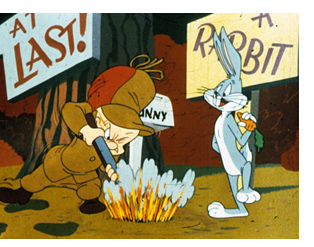
                              <p class="body"><strong>Bugs Bunny<br />
                                </strong>Chuck Jones was part of an innovative
                                team of animators and directors at Warner Brothers
                                that created Bugs Bunny, Daffy Duck, Elmer Fudd,
                                Porky Pig, and all of their friends. Jones himself
                                created a number of memorable characters, including
                                Wile E. Coyote, Road Runner, Pep&eacute; Le Pew,
                                and Marvin the <img src="/interactives/redstudio/images/Elmer_Fudd_Bugs_Bunny.jpg" width="314" height="247" align="left">Martian.
                                Jones once revealed in an interview that &quot;as
                                you become acquainted with a character you are
                                creating, you add parts of yourself that are
                              pertinent to that character.&quot; </p>
                              <p class="body">Bugs Bunny emerged during World War II. In fact,
                                Bob Clampett, one of the animators who works
                                on Bugs, stated that Bugs Bunny was &ldquo;a
                                symbol of America&rsquo;s resistance to Hitler
                                and the fascist powers&hellip;&rdquo; <em>What&rsquo;s
                                Opera, Doc?</em> (1957)&mdash;in which Elmer
                                Fudd chases Bugs Bunny to Richard Wagner&rsquo;s
                                operatic scores&mdash;is often considered to
                                be Jones&rsquo;s masterpiece.&nbsp; The production
                                of this seven-minute film required significantly
                                more work from Jones and his team of animators
                                than any other of the cartoons his studio was
                                producing at the time.&nbsp; </p>
                              <p class="body">About developing Coyote and Bugs, Jones said, &ldquo;The
                                Coyote is limited, as Bugs is limited, by his
                                anatomy. To give the Coyote a look of anticipatory
                                delight, I draw everything up&mdash;the eyes
                                are up, the ears are up, and even the nose is
                                up. When he is defeated, on the other hand, everything
                                turns down. You can&rsquo;t do that as dramatically
                                with human beings, although the emotions expressed
                                are fully human.&rdquo;</p>
                              <p class="body"><strong><img src="/interactives/redstudio/images/NBC_Sally_Jack.jpg" width="263" height="192" align="left">Jack
                                  Skellington <br />
                                </strong>Although bony Jack Skellington, star
                                of the first ever full-length stop-motion animated
                                feature, could stand to gain a few pounds, he
                                certainly doesn&rsquo;t need any extra heads.
                                When making <em>The Nightmare Before Christmas</em>,
                                Jack&rsquo;s animators hand-crafted four hundred
                                separate, interchangeable heads for him, each
                                with a different expression. Just what went into
                                making these hundreds of heads? The puppets&rsquo; skeletons
                                are metal constructions (armatures), which are
                                placed into molds that are then injected with
                                foam latex. They are then sent to the fabrication
                                department to be painted and finished. So not
                                only is stop-motion animation time-consuming,
                                just making the characters and their various
                                body parts is an arduous process. As you can
                                imagine, making <em>The Nightmare Before Christmas</em> took
                                quite a bit of time. Just as in the Wallace and
                                Gromit films, which also use the stop-motion
                                technique, all 227 characters in <em>Nightmare</em> are
                                posed and reposed after each take of the camera,
                                which records the image onto a single frame of
                                film. Even at the height of production, only
                                seventy seconds of finished footage was made
                              in a week!</p>
                              <p class="body"><strong><img src="/interactives/redstudio/images/Princess_Mononoke_1997.jpg" width="325" height="176" align="right">Princess
                                  Mononoke <br />
                                </strong>Can you imagine how many drawings are
                                needed to animate the characters in Hayao Miyazaki's
                                movies? Believe it or not, almost all of them
                                are hand drawn. Miyazaki is arguably one of the
                                most masterful animators of our time. Along with
                                traditional drawing, some three-dimensional computer
                                graphics (CG) are used to create models to animate
                                parts or aspects of the characters&rsquo; bodies.
                                In <em>Princess Mononoke</em>, for example, when
                                monster Tatari-Gami is shot with Ashitaka&rsquo;s
                                arrow, a model of the creature&rsquo;s feelers
                                was made using data from all possible angles
                                and views of the slimy tentacles. CG was used
                                to depict the precise nature of the monster&rsquo;s
                                strained movements. CG is also often used in
                                creating Miyazaki&rsquo;s backgrounds and landscapes,
                              as the movements and textures are less complex. </p>
                              <p class="body">Creating waving grass may be less involved than
                                making gnashing teeth, but the landscape in Miyazaki&rsquo;s
                                films is by no means less important than the
                                monsters.In fact, the environment plays a key
                                thematic role in almost all of his films. He
                                believes that perfect coexistence between humans
                                and nature is nearly impossible, and he explores
                                this idea while maintaining that &ldquo;a wonderful
                                meeting or beautiful thing can exist.&rdquo; </p>
                              <p class="body"><strong>&ldquo;E&rdquo;<br />
                                </strong>The wide range of early character sketches
                                made for Edna Mode shows the variety of styles
                                and interpretations each artist offers to initial
                                character development. Brad Bird, director of <em>The
                                Incredibles,</em> comments, <strong><img src="/interactives/redstudio/images/PXR1092_m.jpg" width="241" height="304" align="right"></strong>&ldquo;Many
                                people have mentioned that the character reminds
                                them of Edith Head, that famous Hollywood costume
                              designer. But there were many inspirations.&rdquo; </p>
                              <p class="body">One source of inspiration was, of course, the
                                storyline that served as a framework for Edna
                                (or &ldquo;E,&rdquo; for short). Bird presents
                                the animators&rsquo; dilemma: &ldquo;We knew
                                that her style had to be somewhat eccentric,
                                and possibly severe. But we ended up making her
                                too dowdy, or too harsh, so that she didn't appear
                                to be somebody who was fun to be around.&rdquo;</p>
                              <p class="body">Another inspiration was an aspect of his own
                                personality. Bird reveals, &ldquo;E is a character
                                who has never known a moment of doubt in her
                                whole life. And I have a little bit of that in
                                me at times. And I like it when I have that in
                                me. She is the only one who really unbalances
                                the superheroes.&rdquo; Believe it or not, Bird
                                ended up being the voice of E in the film! The
                                director would often find his imagination drifting
                                into that distinct accent and voice. Bird jokes, &ldquo;I
                                would say, &lsquo;She's someone who would kind
                                of stand like this, don't you know.&rsquo; And
                                I think that the voice, in a weird way, influenced
                                what they ended up drawing.&rdquo;</p>
                              <p class="body">Finally, the animators arrived at the short
                                and spunky E we all love: "We went for something
                                that was stylish and very simple. Black always
                                looks good. And it goes great with her hair.
                                So you put that with big, black glasses, and
                                it makes a very striking statement.&rdquo;</p>
                              <p><strong><img src="/interactives/redstudio/images/rule.gif" width="520" height="2"></strong></p>
                              <p class="smallText"><em>Pictured above, from top
                                  to bottom:<br />
                                                      <em>Princess Mononoke (Mononoke-hime).</em> 1997.
                                                      Japan. Written and Directed
                                                      by Hayao Miyazaki. &copy; Miramax
                                                      Films. Miramax Films/Photofest </em></p>
                              <p class="smallText"><em>Gertie the Dinosaur.</em> 1914.
                                USA. Directed by Winsor McCay. Box Office Attractions
                                Company/Photofest. &copy; Box Office Attractions
                                Company</p>
                              <p class="smallText"> <em>Steamboat Willie</em>.
                                Walt Disney. 1928. USA. 35mm film, black and
                                white, sound, 8 minutes. Gift of the artist </p>
                              <p class="smallText">Mae Questel (voice of Betty
                                Boop) with Max Fleischer. Credit: Photofest </p>
                              <p class="smallText">Elmer Fudd, Bugs Bunny. &copy; Warner
                                Bros. Warner Bros./Photofest </p>
                              <p class="smallText"><em>The Nightmare Before Christmas</em>.
                                1993. USA. Directed by Henry Selick. &copy; Touchstone
                                Pictures </p>
                              <p class="smallText"><em>Princess Mononoke (Mononoke-hime).</em> 1997.
                                Japan. Written and directed by Hayao Miyazaki. &copy; Miramax
                                Films. Miramax Films/Photofest </p>
                              <p class="smallText">Tony Fucile. Edna Mode from <em>The
                                  Incredibles</em>. Marker and pencil, 11 x 8
                            1/2&quot; (27.9 x 21.6 cm). &copy; Disney/Pixar </p></td>
                          </tr>
                      </table></td>
                    </tr>
                    <tr>
                      <td><img src="../../images/interior/bottom.gif" width="550" height="5"></td>
                    </tr>
                </table>
<?php require_once("../../include/footer.php");?>