Panels like this one, which pairs an image of a crowd of migrants with a caption emphasizing continual movement over time, serve as a refrain throughout the Migration Series. They are periodic reminders of the sheer number of black southerners who left their homes and they underscore the Migration’s dramatic demographic impact. Between 1910 and 1920 more than 400,000 black southerners migrated north; by 1930 the total number exceeded 1.2 million, and by 1950 approximately three million African Americans had left the South. Taken together, Lawrence’s many paintings of migrants traveling side-by-side, whether on foot or by train, offer a politically potent image of collective self-transformation. “It is interesting to note that this migration is apparently a mass movement and not a movement of the leaders,” noted W.E.B. Du BoisScholar, educator, and activist who advocated for black advancement through education Read more in 1917. “The colored laborers and artisans have determined to find a way for themselves.”
They left the South in large numbers and they arrived in the North in large numbers.
They left the South in great numbers. They arrived in the North in great numbers.
- 1941 caption
- 1993 caption
- Close
Two sets of captions accompany Lawrence’s Migration Series: the original 1941 texts and a revised version he wrote in 1993 for a tour of the series organized by The Phillips Collection, Washington D.C. Click on each date to compare the two.
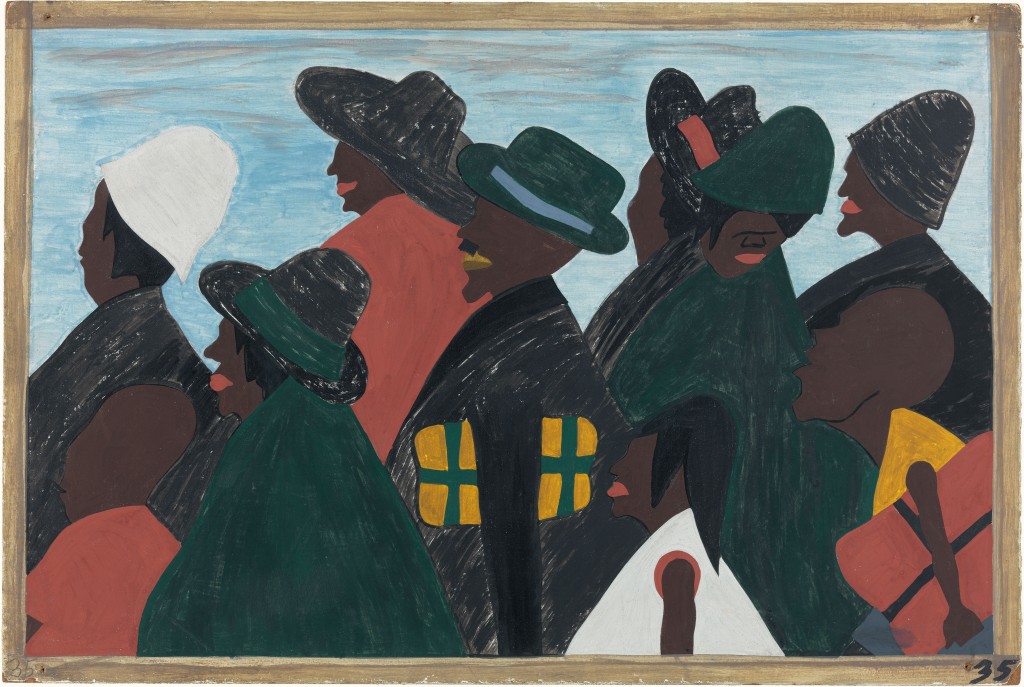
They left the South in large numbers and they arrived in the North in large numbers.
They left the South in great numbers. They arrived in the North in great numbers.
- 1941 caption
- 1993 caption
- Close
Two sets of captions accompany Lawrence’s Migration Series: the original 1941 texts and a revised version he wrote in 1993 for a tour of the series organized by The Phillips Collection, Washington D.C. Click on each date to compare the two.
Lawrence fills this panel with migrants seen from the waist up, their bodies cut off by the borders of the painting. Like a photographer or filmmaker framing a close-up, he composes a partial view of a group that implicitly extends far to the left and right of the picture. Lawrence gives no hint of his figures’ location, instead focusing on the act of moving.