hotspot hotspot hotspot hotspot hotspot

Murals

chronology

Rivera's
New York

Materials &
Technique

Rivera & the Rockefellers

  • about
  • buy tickets
  • checklist
  • events
  • publication
  • credits
  • moma.org
Close
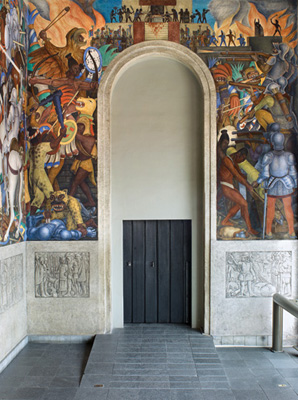
History of the State of Morelos: Conquest and Revolution
Diego Rivera. North wall of the mural cycle History of the State of Morelos: Conquest and Revolution. 1930. Fresco, approx. 19' 10 3/16" x 15' 9 3/4" (6.05 x 4.82 m). Palacio de Cortés, Museo Regional Cuauhnáhuac, Instituto Nacional de Antropología e Historia, Cuernavaca, Mexico. © 2011 Banco de México Diego Rivera & Frida Kahlo Museums Trust, México, D.F./Artists Rights Society (ARS), New York. Photograph © 2011 Eumelia Hernández, Ricardo Alvarado; Instituto Nacional de Bellas Artes

Indian Warrior is a near replica of a scene from Rivera's mural cycle at the Palacio de Cortés in Cuernavaca, Mexico. The portable mural’s source panel illustrates a brutal battle between the Aztecs and the Spaniards, an image inspired by the city’s pre-Columbian history. In April of 1521, the Spanish conquistador Hernán Cortés fought a fierce battle at Cuernavaca in his drive to encircle, and eventually overtake, the Aztec capital of Tenochtitlán.

Codex Mendoza
Page from the Codex Mendoza. c. 1541–52. MS. Arch. Selden. A.1. fol. 64r. The Bodleian Libraries, University of Oxford, U.K.

The details of Aztec culture in Indian Warrior, such as the jaguar knight’s costume, reflect Rivera’s extensive study of pre-Columbian art. In part, the artist’s knowledge of Aztec culture was based on reproductions of post-Conquest books, such as the Codex Mendoza, a 16th-century manuscript commissioned by Spanish royal officials during the tenure of Viceroy Antonio de Mendoza and executed by Indian scribes. Rivera believed that historical research was essential to making pictures that would persuade his audience of the validity of his political statements.
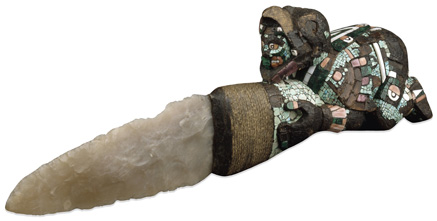
Sacrificial knife
Sacrificial knife. Aztec or Mixtec. 15th–16th CE. Chalcedony blade, carved wood handle with mosaic of turquoise, shell, and malachite. Length: 12.5" (31.7 cm). British Museum, London, Great Britain. © The Trustees of the British Museum/Art Resource, New York

Rivera was an avid collector of pre-Columbian art and artifacts, and he studied objects in ethnographic collections carefully. In Indian Warrior, the jaguar knight’s knife references stone blades commonly used by Mexico’s native people. The weapon in the fresco is relatively simple, of a type used for hunting or warfare, but stone knives could be impressively ornate, equipped with figurative handles covered with mosaics of colorful shells and stones.
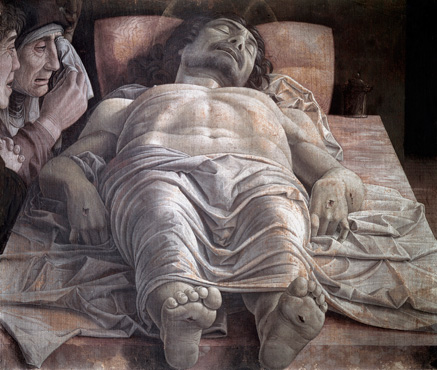
The Lamentation of Christ
Andrea Mantegna (Italian, 1431–1506). The Lamentation of Christ. c. 1480. Tempera on canvas. 27 x 32" (68 x 81 cm). Pinacoteca di Brera, Milan, Italy. Photograph by Scala/Art Resource, New York

While focused on a specifically Mexican subject, Indian Warrior also demonstrates Rivera's intimate knowledge of European artistic traditions. During the winter of 1920 and the following spring, Rivera traveled through Italy, studying the works of Renaissance masters and the technique of fresco painting. His dramatically foreshortened conquistador recalls Italian Renaissance experiments with linear perspective and foreshortening, such as Andrea Mantegna’s Lamentation of Christ of the 15th century.
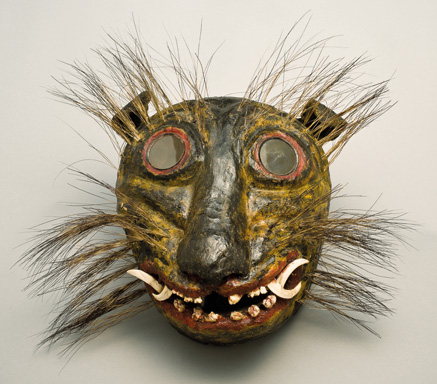
Jaguar mask
Anonymous. Jaguar mask. Mexican. 19th century. Glass, painted wood, animal teeth, and boar bristle, 13 x 12 x 7 1/2" (33 x 30.5 x 19.1 cm). San Antonio Museum of Art. The Nelson A. Rockefeller Mexican Folk Art Collection 85.98.642. Photograph courtesy the San Antonio Museum of Art

For Mexican viewers of the early 1930s, Rivera's jaguar knight was not only a reminder of the nation's pre-Columbian past but also an emblem of modern-day folk culture. In the late 19th and 20th centuries, jaguar costumes appeared in fighting competitions and folk dance performances in numerous Mexican states, including Guerrero, Oaxaca, Puebla, Chiapas, and Tabasco.

prev
next
  • indian warrior
    1931

    indian warrior

  • sugar cane
    1931

    sugar cane

  • liberation of the peon
    1931

    liberation of the peon

  • agrarian leader zapata
    1931

    agrarian leader zapata

  • the uprising
    1931

    the uprising

  • pneumatic drilling
    1931–1932

    pneumatic drilling

  • electric power
    1931–1932

    electric power

  • frozen assets
    1931–1932

    frozen assets

  • Home
  • Menu
  • Murals
  • Indian Warrior
  • Zoom In
  • Zoom Out
  • Annotations turn annotations off
  • Info return to mural Introduction
  • Sound Audio
    • jp-play
    • jp-pause
    Update Required To play the media you will need to either update your browser to a recent version or update your Flash plugin.