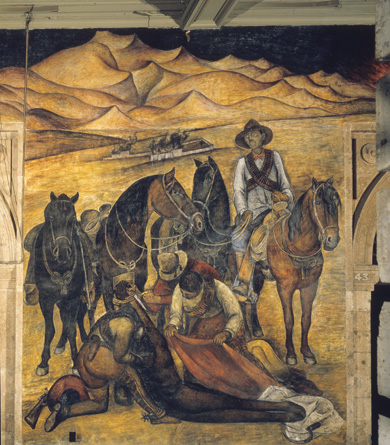
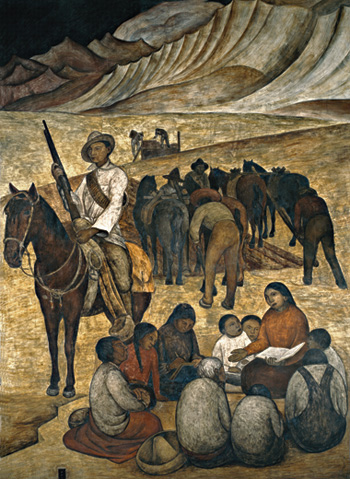
Liberation of the Peon is based on a panel from Rivera’s mural cycle at the Secretaría de Educación Pública in Mexico City. There, the chilling scene captured in this mural panel is coupled with The Rural Schoolteacher, which touts recent efforts to expand state-run education programs and highlights the benefits of post-revolutionary reforms. Shown alone at The Museum of Modern Art, the meaning of Liberation of the Peon shifted to focus on the sacrifice inherent in revolutionary struggle.

While its subject is secular, Liberation of the Peon evokes Christian imagery, specifically the lamentation over Christ’s body after his crucifixion. The composition draws heavily on Giotto’s Lamentation at the Capella degli Scrovegni in Padua, Italy, which Rivera had studied first-hand. He shared this strategy of transforming religious imagery into revolutionary narrative with many Mexican muralists during the movement’s early years.
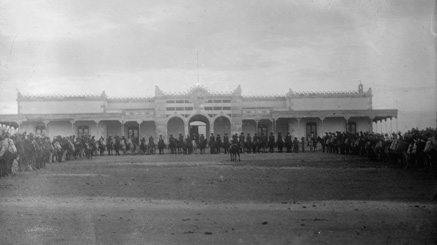
Before the Mexican Revolution, haciendas—vast agricultural estates owned by wealthy Mexicans or foreigners—dominated the country’s social and political landscape. Set ablaze by the rebels in the picture’s foreground, this estate, surrounded by a harsh desert landscape, appears to be located in the northern heartland of Mexico, where the Revolution was launched.

References to Mexican artistic traditions add to Liberation of the Peon’s visceral impact. Devotional imagery created during Mexico’s colonial period was often gory, emphasizing graphic violence and the wounds inflicted on Christ. In his portable mural, Rivera carefully described the individual whip-wounds that cover the peon’s broken body, underscoring the sacrifices made in the revolutionary process.

Rivera signals that the men who care for the peon’s body are revolutionaries by wrapping them in cartridge belts and equipping them with visible firearms. Comprised of mixed groups of rebels, many of whom were untrained, Mexican revolutionary soldiers lacked a single, easily recognizable uniform, and often fought in their usual work clothes.