The tools held by the workers in Pneumatic Drilling function as prosthetic extensions of their bodies. Rivera viewed this alliance between man and machine as a kind of natural force, saying, “We are the catalysts that transform the raw materials of the earth into energy. We are a continuation of the geologic process.”
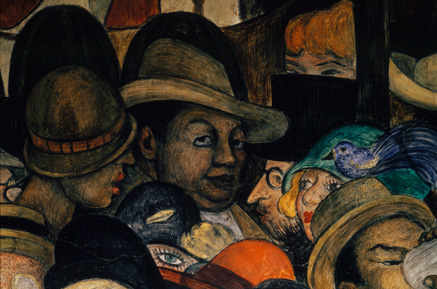
Rivera promoted an image of himself as a common worker; he often wore denim overalls and boasted that early in his career he earned the wages of a housepainter. He also frequently included inconspicuous images of himself in his murals. With this in mind, it is possible to view the rotund figure seen from the back in Pneumatic Drilling as a disguised self-portrait identifying the artist as a manual laborer.
.jpg)
-AMod-RivDi-1408_R2.jpg)
While working on his portable murals at The Museum of Modern Art, Rivera made sketching excursions to construction sites throughout the city, including Rockefeller Center. The scale of the project—a multi-building complex that in its final state fills three city blocks—must have impressed Rivera and appealed to his faith in modernization’s potential for social transformation. The site’s excavation stage alone involved eight steam shovels, one hundred trucks, and more than two hundred men.
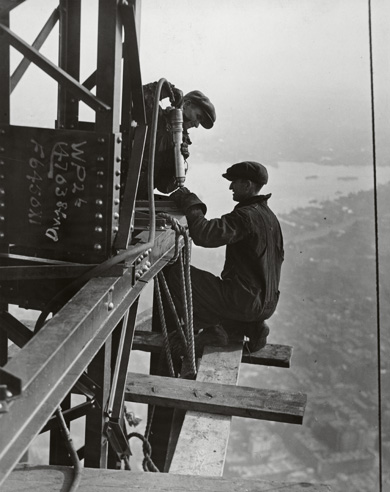
The New York Herald Tribune described Pneumatic Drilling as a “portrait of the activity of excavating for a building foundation, with men drilling, derricks heaving, and trucks going in and out of excavation.” Rockefeller Center’s head architect, Raymond Hood, planned for the site to extend not only precipitously upward by way of impressive skyscrapers, but also below ground. Rivera hints at this innovative design by focusing on construction workers digging deep into the earth. This portable mural also serves as a counterpoint to Lewis Hine’s renowned photographs documenting the dangers faced by construction workers balanced precariously in midair on the girders of new skyscrapers.