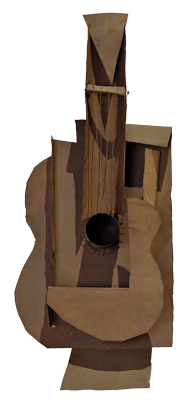
"What is it? Does it rest on a pedestal? Does it hang on a wall? What is it, painting or sculpture?" These are the questions Picasso's sheet metal Guitar prompted from bewildered visitors to his studio, according to French poet and art critic André Salmon. To these queries the artist is said to have replied, simply, "It's nothing, it's el guitare!” Like its cardboard predecessor, Picasso's Guitar broke with the traditions of carved and cast sculpture. Its projecting planes, including the lower extension, create a sense of volume, generating real shadows rather than the rendered shading historically used to simulate depth in painted and graphic art. British artist and writer Wyndham Lewis memorably remarked that many of Picasso's early constructions, the cardboard Guitar implicitly among them, did "not seem to possess the physical stamina to survive.” His words suggest one reason why Picasso may have chosen to memorialize the revolution announced by his fragile cardboard instrument in the more permanent material of sheet metal, in planes connected with wire in just a few ingeniously selected spots.