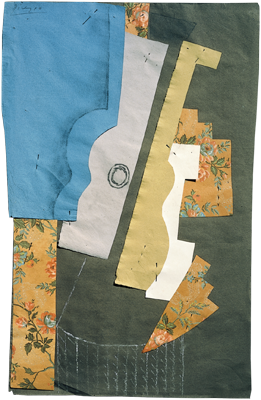
In the early 1930s Surrealist writer André Breton noted the radicality of Picasso's dismissal of marble, bronze, or oil on canvas in favor of ephemeral paper: "Picasso has gone out of his way to seek out the perishable and ephemeral for their own sake. . . . Light has faded the great blue and pink cut-outs, and humidity has cunningly warped them in places." Held together with nothing more than pins, this papier épinglé has preserved its improvisatory air for nearly a century. Its bright papers, embellished with a few additions of chalk and charcoal, contrast strongly with the relatively austere newspaper clippings pasted on white-paper supports that filled the artist's studio the previous winter, and it numbers among the half-dozen very vibrantly colored works Picasso executed in Céret in the spring of 1913. Its layered cutouts create real relief and cast real shadows.