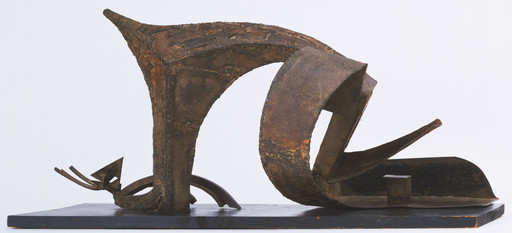
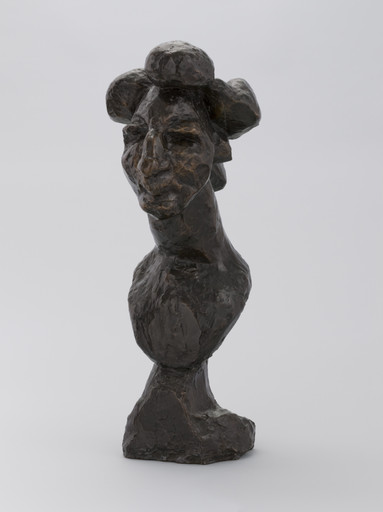
"To draw in space": that, for González, was the exciting possibility in the art of his time. A painter and draftsman as well as a sculptor, González realized that by cutting, rolling, and bending metal, or fusing found metal pieces into an assemblage, he could draw images not on paper but in air, his instrument not a pencil but a welding torch. He often worked in iron, a tough, unyielding material utterly lacking in the fine sinuosity of the precious metals. The stiff spine, shallow curves, and spiky, spearlike lines and points of Woman Combing Her Hair seem integral to the medium itself, but the work tempers its austerity with a subtle eroticism.
González himself associated iron with weaponry and with engineering, but wanted to direct it elsewhere. "It is high time," he wrote, "that this metal cease to be a murderer and the simple instrument of an overly mechanical science. Today, the door is opened wide to this material to be . . . forged and hammered by the peaceful hands of artists." Decorative ironwork is a Spanish tradition, and González learned it as a young man, but considered it only a craft until, in 1928, he began to advise Pablo Picasso on making iron sculpture—an experience that inspired him to become a sculptor himself.
The Museum of Modern Art, MoMA Highlights, New York: The Museum of Modern Art, revised 2004, originally published 1999, p. 168.
Explore more
From MoMA Design Store


Licensing
Artwork or archival images
If you would like to reproduce an image of a work of art in MoMA's collection, or an image of a MoMA publication or archival material (including installation views, checklists, and press releases), please contact Art Resource (publication in North America) or Scala Archives (publication in all other geographic locations).
Audio and film clips
MoMA licenses archival audio and select out of copyright film clips from our film collection. At this time, MoMA produced video cannot be licensed by MoMA/Scala. All requests to license archival audio or out of copyright film clips should be addressed to Scala Archives at [email protected]. Motion picture film stills cannot be licensed by MoMA/Scala. For access to motion picture film stills for research purposes, please contact the Film Study Center at [email protected]. For more information about film loans and our Circulating Film and Video Library, please visit Circulating Film and Video Library.
Text from a publication or the archives
If you would like to reproduce text from a MoMA publication, please email [email protected]. If you would like to publish text from MoMA's archival materials, please fill out this permission form and send to [email protected].
Feedback
This record is a work in progress. If you have additional information or spotted an error, please fill out this feedback form.