Portfolio of eleven lithographs (including cover)
Not on view
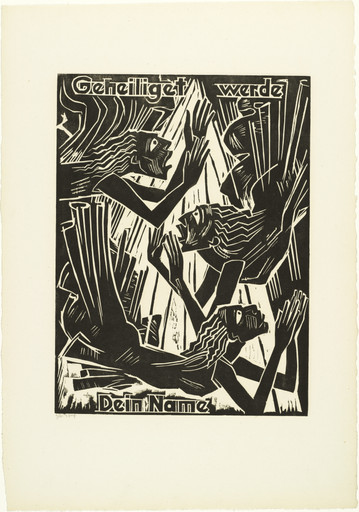
As depicted in Max Beckmann's portfolio Berliner Reise 1922 (Trip to Berlin 1922), in the years just after revolutionary upheavals following Germany's defeat in World War I, Berlin is a city of disillusioned people quietly resigned to their fates. Neither politics nor sex can rouse any interest. The rich play cards, attend the theater, and while away the hours in boredom. The poor beg on the street, sleep in cramped quarters, and enjoy the momentary distractions of a dive bar.
In these prints, Beckmann chronicles the many sides of life in the capital of the new Republic. Emphasizing the claustrophobic and discordant, he compresses scenes in tight, windowlike frames that barely contain the figures that fill them. By contrast, he depicts himself alone in three self-portraits, as an outsider who observes but does not participate, arriving in the city with suitcase in hand, sitting in his hotel room, and, as a chimneysweep in the final print, surveying the city in the new dawn.
PUBLISHING HISTORY
Beckmann conceived of this series as a sequel and moral complement to Hölle (Hell), his 1919 portfolio of postwar Berlin. He visited Berlin in early 1922, and by April the lithographs were ready for printing. Pleased, he wrote to publisher J. B. Neumann: "I think it ended up being a good and actually quite amusing thing."
Heather Hess, German Expressionist Digital Archive Project, German Expressionism: Works from the Collection. 2011.
Gallery label from German Expressionism: The Graphic Impulse , March 27–July 11, 2011.
In this portfolio, made three years after the revolutionary upheavals of 1919, Berlin is a city of disillusioned people quietly resigned to their fates. The rich play cards, attend the theater, and while away the hours in boredom. The poor beg on the street and enjoy the momentary distractions of a dive. Beckmann compressed his scenes into tight, windowlike frames that barely contain their inhabitants, creating a sense of claustrophobia and discord. He lived in Frankfurt but visited the capital in 1922 to create these prints, which he conceived as a sequel to his portfolio Hell (1919).
Provenance Research Project
This work is included in the Provenance Research Project, which investigates the ownership history of works in MoMA's collection.
Buchholz Gallery, New York; to The Museum of Modern Art, New York, 1951
Provenance research is a work in progress, and is frequently updated with new information. If you have any questions or information to provide about the listed works, please email [email protected] or write to:
Provenance Research Project
The Museum of Modern Art
11 West 53 Street
New York, NY 10019
Explore more
Max Beckmann
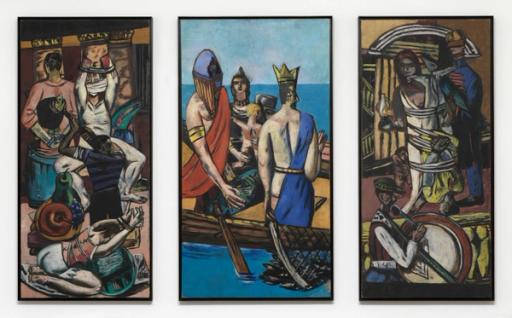
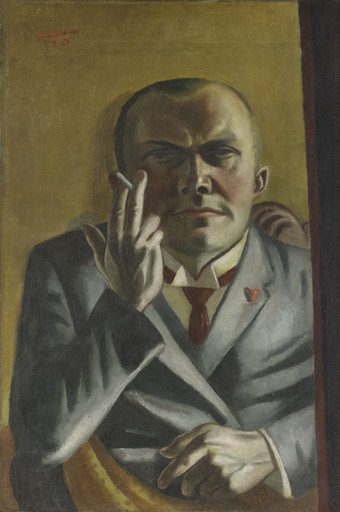
German, 1884–1950 218 works onlineMax Beckmann dreamed up a world of actors, cabaret singers, heroes, and thugs, whose dramas unfold on city streets, at masquerades and carnivals, and in candlelit chambers.
Learn more →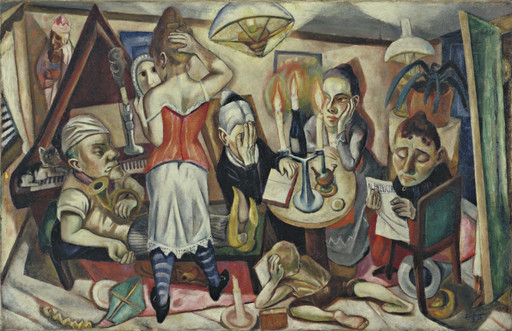

From MoMA Design Store


Installation views
We have identified this work in the following photos from our exhibition history.
Licensing
Artwork or archival images
If you would like to reproduce an image of a work of art in MoMA's collection, or an image of a MoMA publication or archival material (including installation views, checklists, and press releases), please contact Art Resource (publication in North America) or Scala Archives (publication in all other geographic locations).
Audio and film clips
MoMA licenses archival audio and select out of copyright film clips from our film collection. At this time, MoMA produced video cannot be licensed by MoMA/Scala. All requests to license archival audio or out of copyright film clips should be addressed to Scala Archives at [email protected]. Motion picture film stills cannot be licensed by MoMA/Scala. For access to motion picture film stills for research purposes, please contact the Film Study Center at [email protected]. For more information about film loans and our Circulating Film and Video Library, please visit Circulating Film and Video Library.
Text from a publication or the archives
If you would like to reproduce text from a MoMA publication, please email [email protected]. If you would like to publish text from MoMA's archival materials, please fill out this permission form and send to [email protected].
Feedback
This record is a work in progress. If you have additional information or spotted an error, please fill out this feedback form.